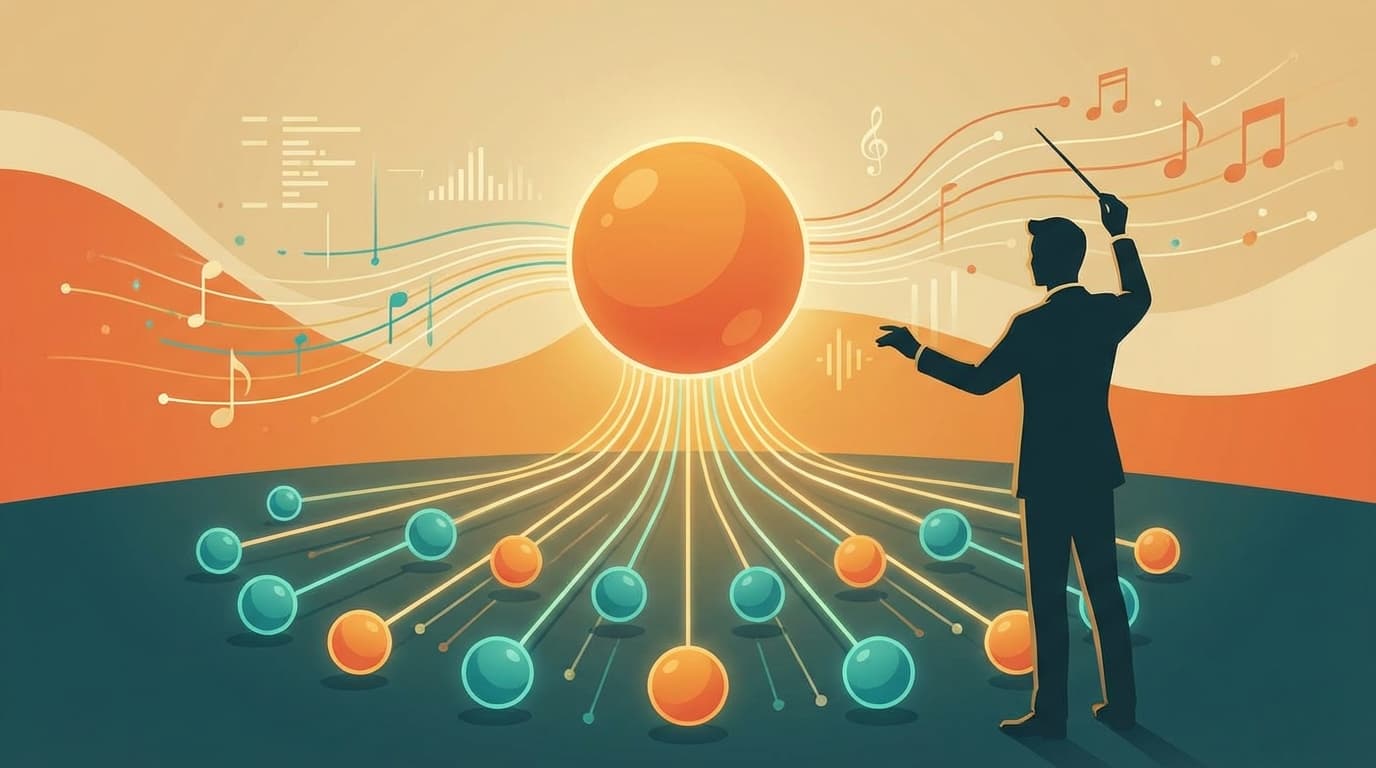
Your First Orchestra: From Solo Act to Multi-Agent Symphony
By Conny Lazo
Builder of AI orchestras. Project Manager. Shipping things with agents.
You're doing it wrong.
I see you there, running one Claude instance, copying and pasting between tabs, manually coordinating everything. I was you six months ago. Then I built my first orchestra and everything changed.
Here's how you build yours.
Start Small, Think Big
Forget the fantasy of 10 agents working in perfect harmony on day one. That's a recipe for chaos.
Your first orchestra needs exactly two players: one conductor, one musician.
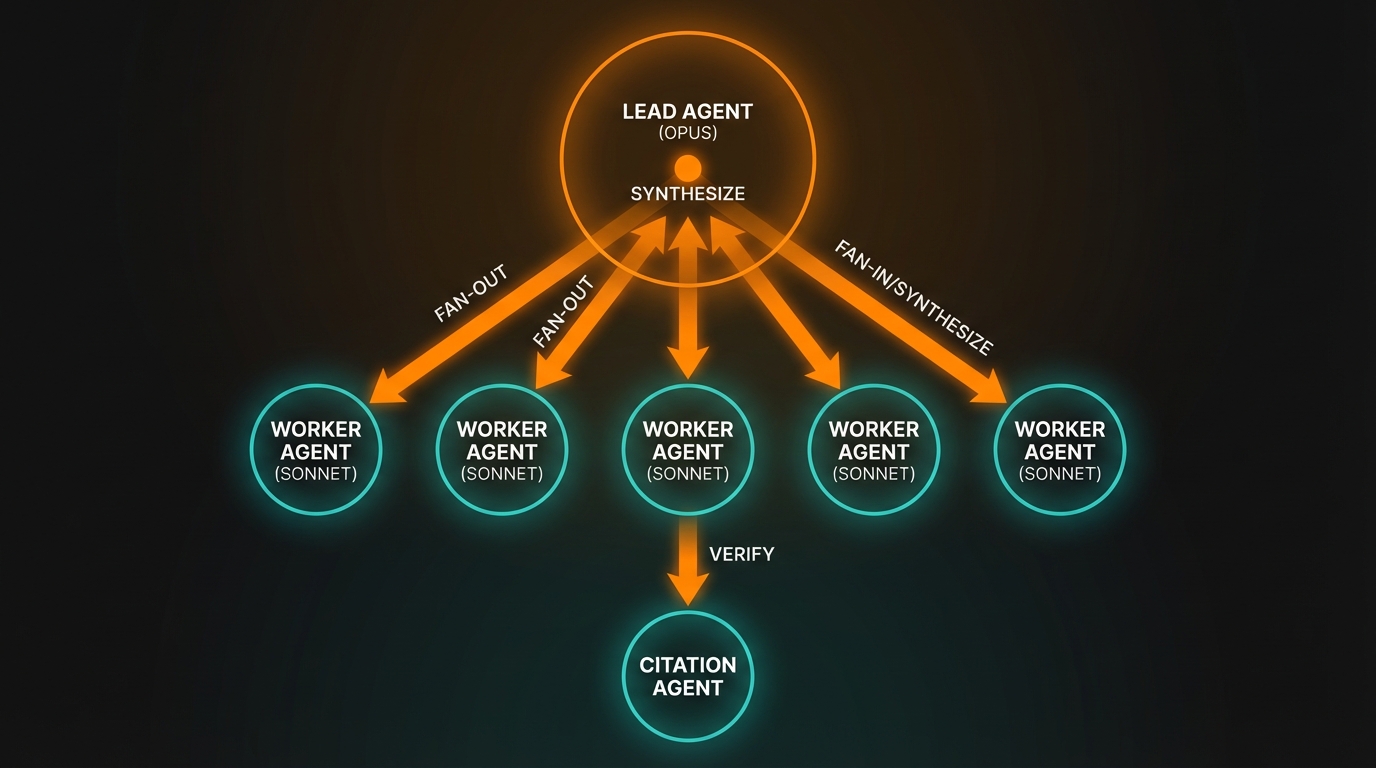
I started with a Research Orchestra. Simple pattern: Opus as the conductor, Sonnet as the worker. Opus breaks down the research topic into subtopics. Sonnet researches each one in parallel. Opus synthesizes the results.
That's it. Two agents, clear roles, immediate value.
I used this pattern to research CPMS architecture patterns. What used to take me 4 hours of manual research now takes 15 minutes. The Sonnet worker pulls sources while I'm in meetings. The Opus conductor delivers me a complete brief when I'm ready.
The Research Orchestra Pattern
This became my template for everything. It's the most useful pattern you'll learn.
Phase 1: Fan-out
- Lead agent (Opus) breaks the problem into parallel subtasks
- Worker agents (Sonnet) tackle each subtask independently
- No coordination between workers needed
Phase 2: Fan-in
- Lead agent collects all worker results
- Synthesizes, fact-checks, delivers final output
- Citation agent verifies sources (if needed)
I built a Deep Research Orchestra using this pattern. One Opus conductor, five Sonnet researchers, one citation agent. 46 sources verified in 20 minutes. Try doing that manually.
The beauty? It scales linearly. More workers = more parallel research. The conductor stays the same.
The Code Shipping Orchestra
Research was just the warm-up. Then I built something that changed how I ship code.
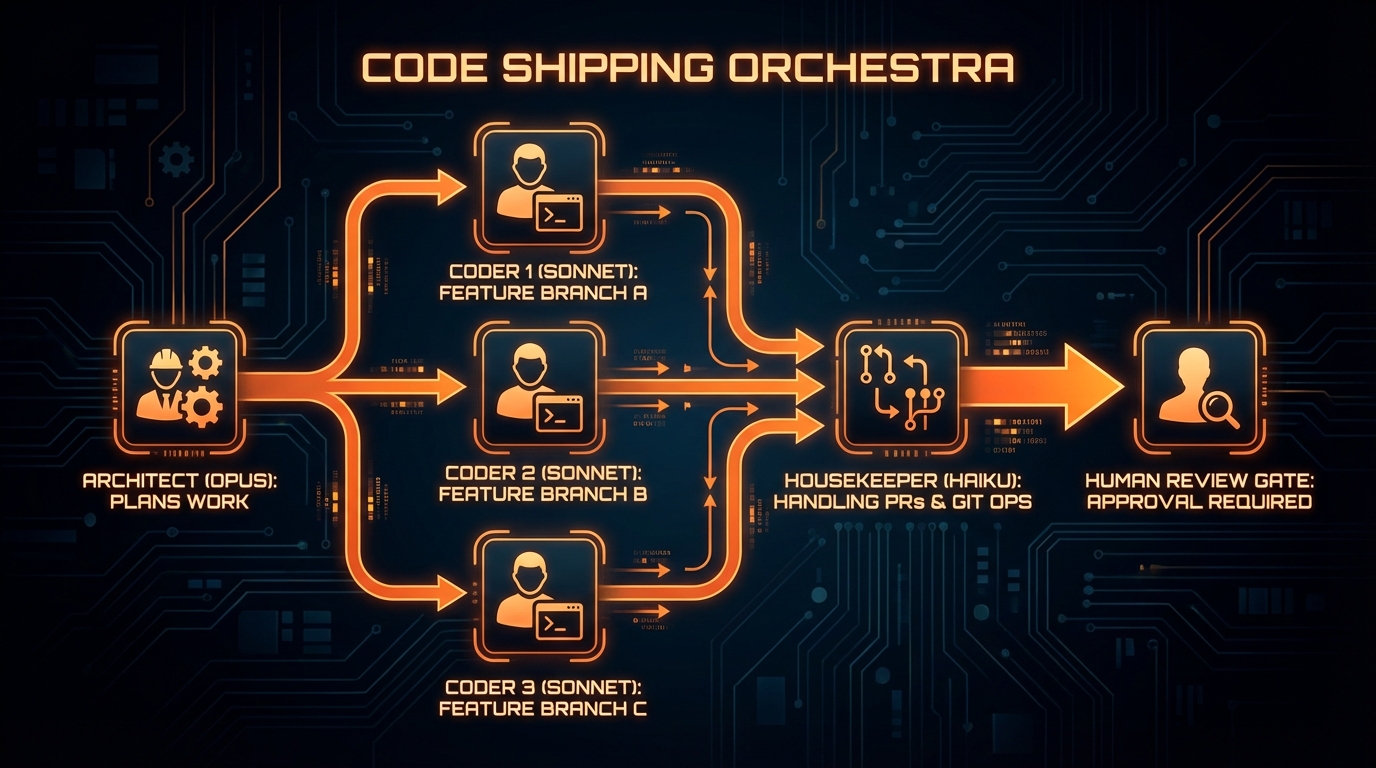
Three-tier system:
- Opus (Architect): Plans the work, makes decisions, designs interfaces
- Sonnet (Coder): Implements features on separate branches
- Haiku (Housekeeping): Creates PRs, runs tests, handles git operations
I used this to build Text Grand Central's translation pipeline. The Architect planned 6 microservices. Three Sonnet coders implemented them in parallel on feature branches. Haiku handled the merge choreography.
Result? What used to be a 2-week solo project took 3 days with the orchestra. And the code quality was better because each agent had one clear job.
Token Economics: The Secret Sauce
Here's what nobody tells you: model selection is everything.
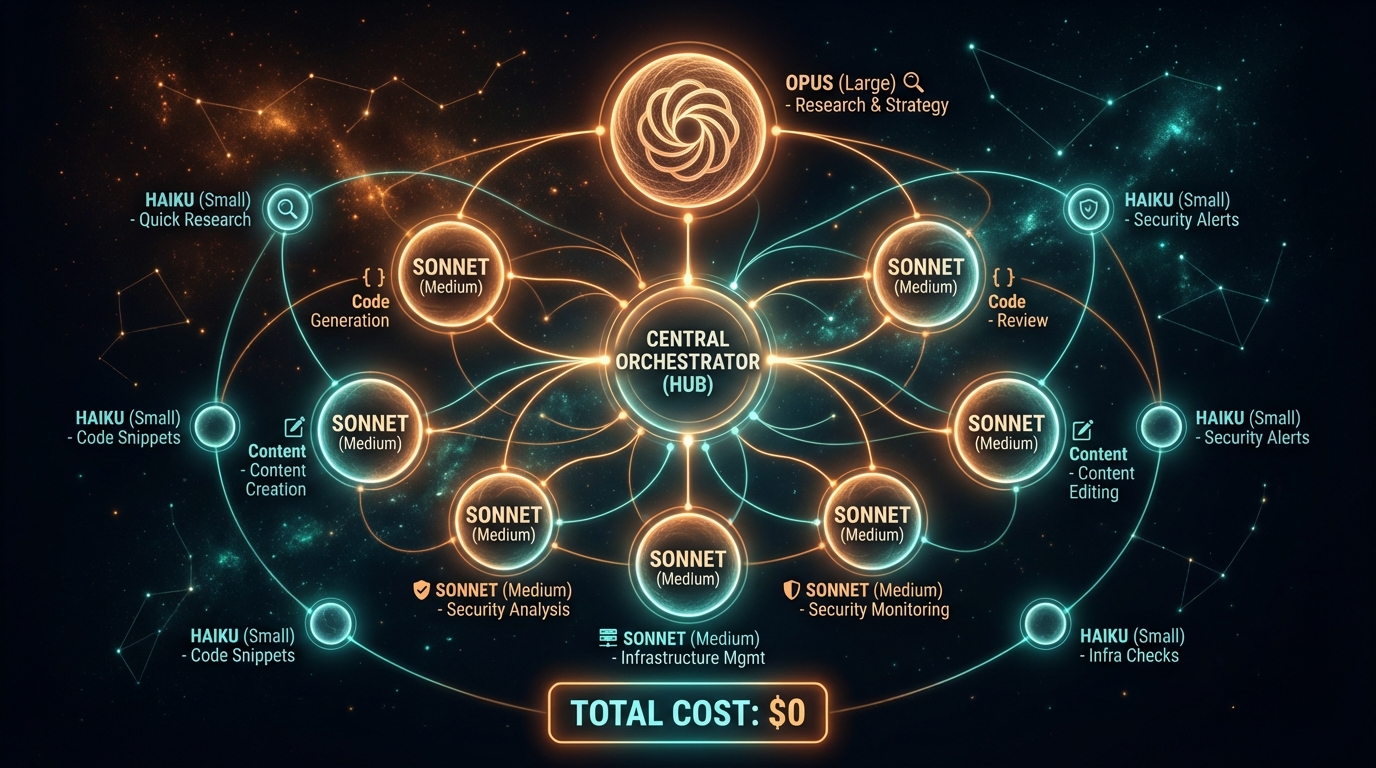
I run a three-tier system:
- Haiku: File operations, formatting, git commands ($0.25/1M tokens)
- Sonnet: Code generation, research synthesis ($3/1M tokens)
- Opus: Architecture decisions, complex reasoning ($15/1M tokens)
Use the cheapest model that can do the job reliably.
My CPMS Planning Orchestra generated 114 GitHub issues from 46KB of research. Total cost? $0. I'm on Claude's max subscription, but even paying per token, it would've been under $2.
Most tasks don't need Opus. I reserve it for the hard problems: system design, debugging complex interactions, creative strategy work. Everything else runs on Sonnet or Haiku.
Your wallet will thank you.
When Things Go Wrong
Agents fail. Get used to it.
I built fallback chains into every orchestra. Sonnet can't handle the task? Falls back to Opus. Opus is overloaded? Queue the request and retry in 30 seconds.
The key is designing for failure from day one.
My Content Pipeline Orchestra has three fallback levels:
- Sonnet tries the task
- Falls back to Opus if it fails
- Falls back to human-in-the-loop for critical decisions
I learned this the hard way when a Sonnet agent hallucinated citations in a LinkedIn article. Now every fact gets verified by a separate agent before publication.
The 13-Agent Afternoon
Let me show you what's possible.
Last Tuesday, I ran 13 sub-agents simultaneously. All on my Claude Max subscription. Total cost: $0.
What they built:
- Research Orchestra: Analyzed 5 competitor translation platforms
- Code Shipping Orchestra: Implemented authentication for The Door portfolio
- Security Audit Orchestra: Scanned 4 repositories in parallel
- Content Pipeline Orchestra: Generated this article series
- Infrastructure Orchestra: Updated Docker configs across 8 services
All while I was in client meetings.
I came back to 47 GitHub issues, 12 feature branches, 3 security reports, and a content calendar for the next month. Everything organized, documented, ready for my review.
That's the power of orchestration.
Your First Orchestra Blueprint
Ready to build? Here's your step-by-step:
Week 1: Build a Research Orchestra
- One Opus conductor, one Sonnet worker
- Pick a topic you research regularly
- Let the Opus break it into subtopics
- Let the Sonnet research each subtopic
- Measure the time savings
Week 2: Add error handling
- Implement fallback chains
- Add retry logic with exponential backoff
- Build human-in-the-loop triggers
Week 3: Optimize costs
- Move simple tasks to Haiku
- Reserve Sonnet for synthesis work
- Use Opus only for architecture decisions
Week 4: Scale horizontally
- Add more Sonnet workers
- Test parallel execution
- Monitor token usage
Don't try to build everything at once. Master one pattern, then expand.
The Learning Curve
Azure documented this years ago: sequential agents for handoffs, concurrent agents for parallel work, hierarchical systems for complex orchestration. The patterns exist. You just need to implement them.
I learned from n8n's multi-agent tutorials and the 9 agentic workflow patterns research. McKinsey's "one year of agentic AI" report validated what I was seeing: parallelization works, but coordination is everything.
The difference between theory and practice? I actually built these systems. In production. With real stakes.
Start Today
Your first orchestra is waiting. Pick one repetitive task you do weekly. Break it into conductor + worker roles. Build it this weekend.
The compound effect starts with the first note.
Next week, I'll show you how to scale from one orchestra to an entire AI organization. How memory systems keep your agents sharp. How monitoring prevents chaos.
But first, build your Research Orchestra. You'll thank me on Monday.
Sources & Inspiration
- Azure AI Agent Design Patterns — Sequential, concurrent, group chat, handoff, magentic patterns
- n8n Multi-Agent Systems Tutorial — Hierarchical system with main agent coordinating sub-agents
- 9 Agentic Workflow Patterns — Parallelization for code review, candidate evaluation, A/B testing
- McKinsey Agentic AI Lessons — One year of practical experience insights
- Multi-Agent Guide 2026 — Task delegation, inter-agent communication, state management
- 50 Real-World AI Agent Use Cases — Practical examples with manual vs agent comparisons
- Google ADK Multi-Agent Patterns — SequentialAgent examples, real-world enterprise combinations
Previously in this series:
More from “Build Your Own Orchestra”
Setting Up Your Stage: Infrastructure for AI Agent Orchestration
Your agents need their own home. Here's how I built mine.
Choosing Your Conductor: The AI Engine That Runs Your Orchestra
Your model choice makes or breaks everything. Here's what actually works.
Building the Stage: Platforms and Tools for AI Orchestration
The platform you choose determines what's possible. Here's what actually works.
The Compound Effect: From One Agent to an AI Organization
How I scaled from 1 agent to 13+ orchestras running simultaneously, and why memory is everything.