The Seasons Always Change
By Conny Lazo
Builder of AI orchestras. Project Manager. Shipping things with agents.
The most dangerous illusions we build do not announce themselves with a crash; they arrive disguised as a permanent new reality.
The surrender of a rational mind to mass hysteria usually happens quietly over coffee.
A few days ago, I met with my friend Leo. Leo is a pragmatist by trade—he runs a landscaping business. He wakes before dawn, carries the literal weight of his work on his shoulders, and possesses a visceral understanding of what a euro actually costs in human sweat.
But when he sat in front of me, he was excited to share something personal, he pushed his smartphone across the table.
On the screen was a neon green line practically climbing off the glass. It was the chart for Nvidia—the beating heart of the artificial intelligence boom.
"Conny," he said, lowering his voice as if dealing in contraband. "I put half my savings into this last month. It doubled. They are trading at trillions in market cap. Trillions. I think I finally figured out the game. And the best part? Every analyst on the news says this time is different."
I looked at him and then back at the glowing rectangle telling him he could generate more wealth in thirty days of doing absolutely nothing than in a year of breaking his back.
I didn't scold him. I didn't tell him to sell in a panic. I just smiled, took a sip of my coffee, and felt a familiar, sharp nausea settle in my gut.
I didn't judge him, because I am intimately acquainted with the rot of that exact hubris. I know exactly what the fever feels like.
"I'm happy for you, Leo," I told him, meaning it. But looking in his eyes, I knew no historical warning would register. You cannot explain gravity to a man who believes he has just learned how to fly. You can only wait for him to hit the ground.
I didn't give him a condescending lecture on market fundamentals. I just paid for the coffees. Because what I was looking at wasn't a financial strategy; it was an emotional pathology.
The Pathology of "This Time is Different"
Human beings are defined by hope and crippled by recency bias. We desperately want a temporary high to be a permanent physiological baseline. When a market surges, we don't just mistake the crest of a wave for a permanent change in sea level—we build our houses on the water and declare ourselves gods of the ocean.
Right now, the global market has taken the deepest breath in financial history and is holding it at the absolute peak. Giant technology companies are taking on massive debt to build sprawling data centers that gorge on the electrical grid, all predicated on the assertion that artificial intelligence will instantaneously rewrite the laws of human productivity.
And everywhere, the chorus chants the five most expensive words in the history of capital: "This time it is different."
When you hear those words, you must anchor yourself. They are not an economic analysis; they are a psychological defense mechanism against the terror of financial gravity.
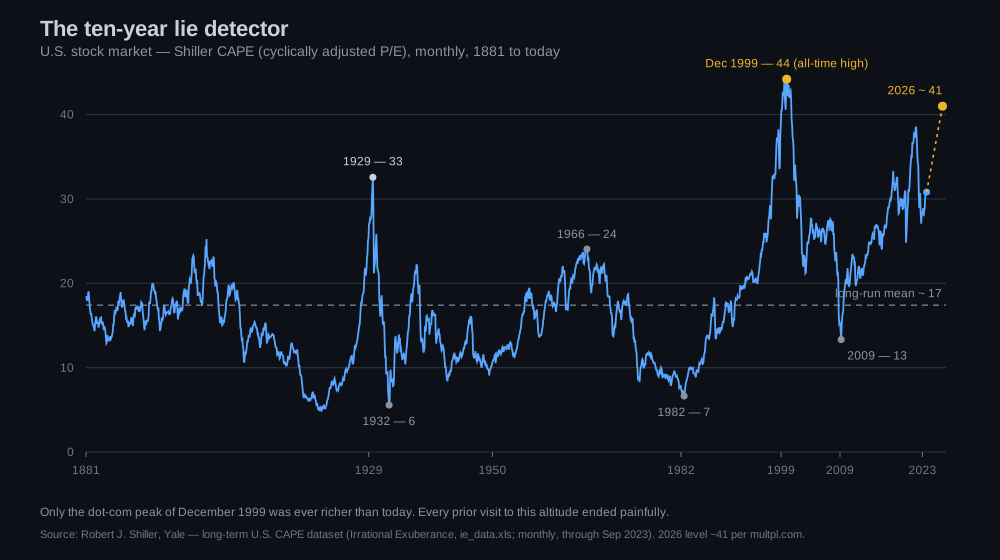
In finance, gravity is measured in cycles. The cyclically adjusted price-to-earnings ratio (the Shiller P/E) is essentially a ten-year lie detector. If you judge an athlete by his single most manic, adrenaline-fueled game, you might hand him a hundred-million-dollar contract on the spot. That is how bubbles are built. But if you look at his ten-year baseline—smoothing out the lucky streaks and the miserable slumps—you see the sobering reality of who he actually is.
Right now, the ten-year lie detector for the U.S. stock market is flashing an uncompromising warning. We are sitting at the second most expensive peak in recorded history. Wall Street is projecting endless margin expansion in an economy where the average person is drowning. They are pricing in a world where the sun simply refuses to set.
Watch: Robert Shiller explains the CAPE ratio.
Echoes from a 1955 Classroom
History is not a circle, but it is a relentless, repeating spiral. The technology changes; the underlying human neuroses do not.
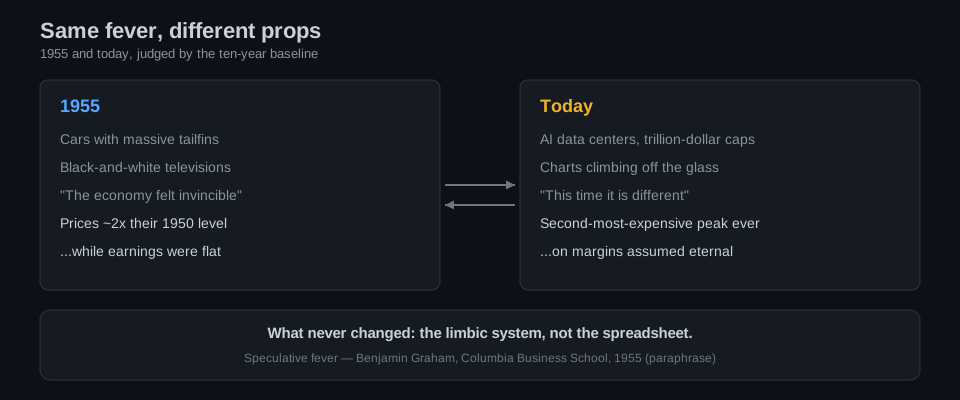
In 1955, the brilliant investor Benjamin Graham stood before a seminar at Columbia University. The post-war world felt unprecedented. People were driving cars with massive tailfins, and the economy felt utterly invincible. Graham asked his students a simple question: Why were stock prices twice as high as they had been in 1950, even though the companies themselves were not making more money?
His answer circumvented math entirely and struck at the core of behavioral psychology. Investors, he noted, were simply paying a premium for optimism. They had contracted a speculative fever. Graham understood that the machinery of the market is driven by our limbic systems, not our spreadsheets. We remain aggressively exuberant in times of plenty, and irrationally panicked in times of scarcity.
Watch: Benjamin Graham lecturing at Columbia Business School, 1955.
Temporal Alchemy and The Second Gilded Age
To understand the macro-environment enabling this delusion, you have to strip away the complex jargon and look at the basic temporal mechanics of credit.
The grand illusion of the modern era is how we perceive capital. Most of the "money" circulating today is not wealth; it is temporal alchemy. Credit is the act of bleeding your future self to inject adrenaline into your present. When you borrow, you pull tomorrow's consumption into today. You create a legal, binding promise that eventually, you will consume less than you produce to settle the ledger.
As a society, we have spent the 2020s borrowing relentlessly against a future we haven't built yet. To survive systemic shocks, central banks flooded the system with liquidity. But that capital did not distribute evenly. It aggregated at the absolute top, artificially inflating asset prices and enriching those who already owned the assets.
This dynamic has triggered a profound, structural schizophrenia in our reality.
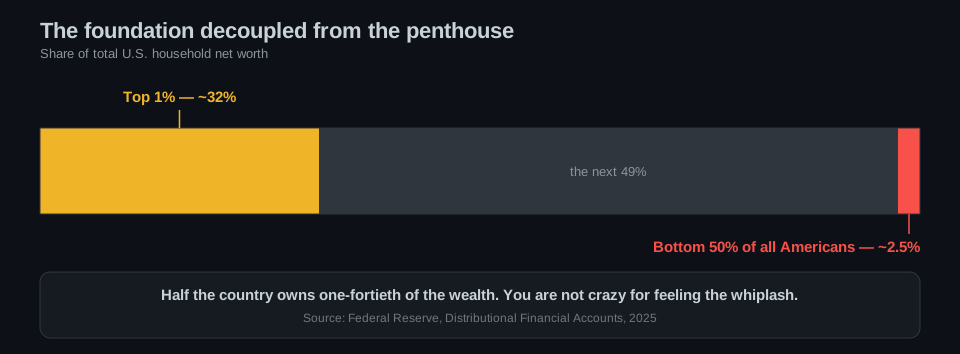
If you measure the world by the S&P 500, we are living in a utopian golden age. The top one percent of Americans control roughly a third of all wealth. Their luxury spending props up the illusion of a robust macroeconomy. But zoom out, and the structural rot is deafening. Core inflation has permanently raised the floor on survival. White-collar professionals are watching AI systematically threaten their leverage, while everyday people finance basic groceries on credit cards carrying staggering interest rates.
You are not crazy for feeling the whiplash. The foundation has completely decoupled from the penthouse. We have entered the Second Gilded Age.
During the First Gilded Age of the late 19th century, robber barons monopolized railroads and oil, building literal empires while the labor force lived in squalor. The elite utilized their staggering wealth to capture the regulatory apparatus of the state. Today's tech monopolies execute the exact same playbook. They leverage trillions in market cap to buy political insulation, establishing a neo-oligarchy where the market isn't a meritocracy of ideas, but a walled fortress designed to protect the incumbents.
Watch: Why some experts say we're living in a second Gilded Age (ABC News).
The Inevitable Exorcism
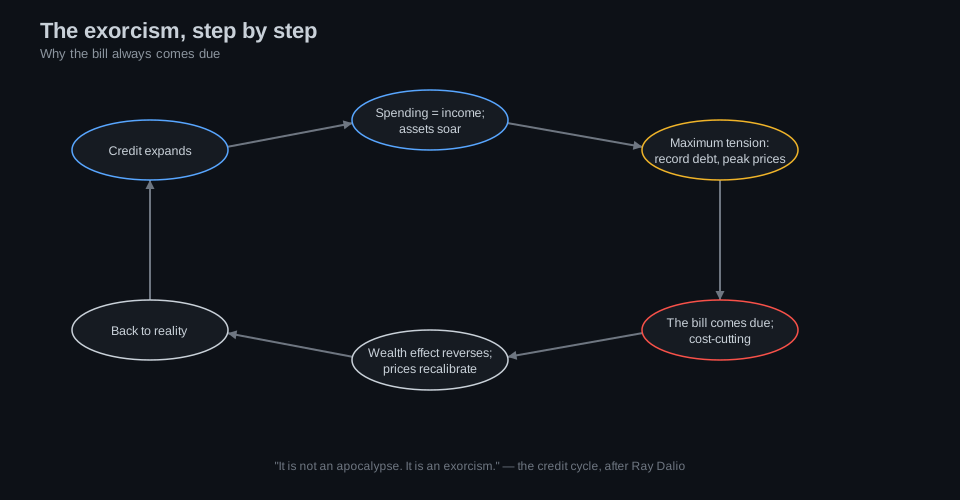
But here is where fierce pragmatism meets genuine optimism: No system can sustain a permanent state of maximum tension. Equilibrium is a law of physics, and it is a relentless law of history.
Tech valuations cannot expand into infinity. Eventually, the bill for the AI infrastructure build-out comes due. If the technology fails to instantly revolutionize corporate profit margins, the return on investment evaporates. The tech giants will be forced to service their massive debts by initiating severe cost-cutting.
Because one person's spending is inevitably another person's income, the wealth effect will reverse. Equities will drop, the elite will stop spending, prices will violently recalibrate to actual demand, and the synthetic credit will vanish.
The media will frame this deleveraging as an apocalypse, complete with blood-red ticker tape and panic in the streets. It is not an apocalypse. It is an exorcism. It is the necessary, systemic clearing of dead wood so new growth can finally reach the canopy.
Watch: Ray Dalio — How the Economic Machine Works.
Fortifying the Moat
What do we do with this knowledge? How do we operate in the shadow of a macro-correction?
First, you must aggressively decouple your psychological stability from the macroeconomic cycle. If you chased the green line, accept it, secure your gains if you have them, and step away from the casino. Divest your ego from your portfolio.
True wealth is not market cap; it is resilience. It is the sovereignty of your attention, the depth of your local community, and the non-automatable skills you bring to the marketplace.
The shift from the macro to the micro is where you reclaim your agency:
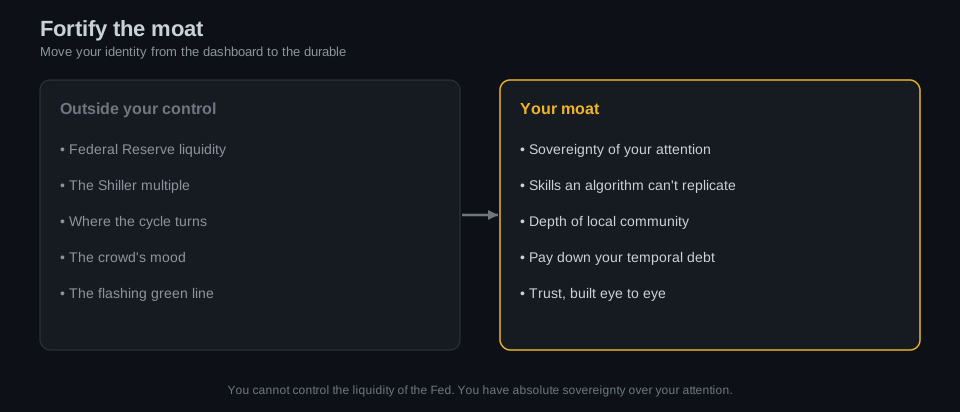
1. Audit Your Temporal Debt: Where are you pulling future stability into the present? Whether it is leveraging your portfolio on margin, or neglecting your primary relationships to chase a professional high, identify your emotional and financial debt. Pay it down before reality forces a deleveraging.
2. Invest in Tangible Leverage: Move your identity away from paper assets. Build skills that an algorithm cannot replicate. If the market drops 40%, your ability to fix, build, persuade, and lead remains untouched. An algorithm cannot replicate the trust you build looking someone in the eye.
3. Divorce the Dashboard: Cut the dopamine drip of the stock tickers. You cannot control the liquidity of the Federal Reserve, but you have absolute sovereignty over where you deploy your attention. Interrogate your operating system: Are you deploying your capital out of disciplined strategy, or are you acting out of the primal, desperate fear of missing out?
Take fifteen minutes today. Leave your phone in another room. Sit in silence and interrogate your foundation:
Am I deploying my energy out of a desperate fear of missing out, or am I building an antifragile life?
If the numbers on my screen vanished tomorrow, what undeniable, un-stealable value do I actually bring to my family and my community?
Am I outsourcing my peace of mind to an abstract digital dashboard?
You possess significantly more agency than a flashing green line dictates. Humanity has survived market panics, hyperinflation, and Gilded Ages before. We always purge the rot and build something marginally better in the aftermath.
"This time is different" is a psychological sedative meant to keep you playing a rigged game. The fierce truth is much more demanding, and ultimately, much more empowering: this time is exactly the same as it has always been. The machinery of history will grind forward. The cycle will turn.
Anchor yourself in reality, and let the market exhaust itself.
Sources
- Shiller P/E (CAPE) Ratio: the ten-year "lie detector" — current level and its 155-year history.
- Ray Dalio — How the Economic Machine Works: the credit cycle, "one person's spending is another person's income," and deleveraging.
- Federal Reserve — Distributional Financial Accounts: share of U.S. net worth held by the top 1%.
- Benjamin Graham lecturing at Columbia Business School (1955): original footage — investor psychology and speculation, not earnings.
- Why We're in a New Gilded Age: Paul Krugman on the wealth divides mirroring the late 1800s.