
Amazon Made $16.8 Billion of AI Profit Last Quarter Without Selling Any AI
By Conny Lazo
Builder of AI orchestras. Project Manager. Shipping things with agents.
Amazon Made $16.8 Billion of AI Profit Last Quarter Without Selling Any AI
I use AI every day. The math behind the AI boom is theatrical, not real. Here's what it looks like from inside a finance system.
Picture an accountant at Amazon, last quarter, sitting in a beige conference room with the door closed. He owns a piece of Anthropic, the AI company that makes Claude. Last quarter Amazon's piece of Anthropic was worth X. This quarter the accountant decides it's worth X plus $16.8 billion. He writes the new number. The difference becomes profit. He has not sold anything. He has not built anything. He has not done anything except change a digit on the same piece of paper he was looking at yesterday. He goes home. Wall Street applauds him for $16.8 billion of value he literally invented in his head.
This was, by Fortune's accounting, roughly half of Amazon's "blowout AI profits" for the first quarter of 2026. The lab Amazon funds got more valuable because Amazon funded it more, and the accounting department wrote down the new number, and the new number became income. None of it was earned by selling anything to anyone outside the building. The whole thing is fully legal. It is also the corporate equivalent of pricing your own wedding ring higher and asking your spouse for a raise on the grounds that you are now richer.
I am a day-one ChatGPT user. I climbed the AI stack for three years until I built my own orchestration engine, Orchemist, in three and a half weeks. Every line of it was written by an AI agent. I don't write code — I write specifications and prompts. I spawn agent sessions at breakfast. I am exactly the kind of user the AI industry needs to keep buying the product. I am also a senior program manager and business application owner, which is the corporate way of saying I am the person who has to make the numbers add up after the demo is over. I have spent fifteen years inside the accounting systems where dreams become budget lines. When I look at the AI economy from that seat, the math is not just bad. The math is doing performance art.
Three things are propping the whole thing up. None of them survive a casual reading.
The Demand Is the Spend, Relabeled
Imagine a small dinner party. Six people around the table. Microsoft, Google, Amazon, Meta — the four giant tech companies you've heard of — and the two AI labs they fund, OpenAI and Anthropic. There's a hundred-dollar bill in the middle of the table.
Microsoft picks it up and hands it to OpenAI. OpenAI hands it right back to Microsoft to pay for cloud computing. Microsoft writes it down as AI revenue. Amazon does the same trick with Anthropic. Google with Anthropic again. The same hundred dollars makes the circuit three times in an hour. At the end of the dinner, everyone tells the press they have unprecedented AI revenue. The hundred dollars is still on the table.
This is not a metaphor. Goldman Sachs published a report in May 2026 called Tracking Trillions. It projects $7.6 trillion of AI spending between 2026 and 2031 — $5.1 trillion for chips, $2.15 trillion for buildings to put the chips in, $358 billion for power. The biggest single assumption in the whole projection is how long an AI chip lasts before it's obsolete. Goldman uses around five years. If you change that assumption to three years — which several analysts argue is closer to reality — you add a trillion dollars of value lost each year just from the chips getting old. The headline number, in other words, is held together by an accounting convention.
The four big companies are planning to spend $725 billion on capital projects in 2026, up 77% from last year. About three-quarters of that — $450 billion — goes to AI infrastructure. So the question, the one that breaks the spell, is: who is buying enough AI to justify $450 billion of spending in a single year?
Walk the customer list. Amazon committed up to $25 billion more in Anthropic in April, on top of $8 billion already poured in. In the same deal, Anthropic agreed to spend $100 billion at Amazon Web Services over the next ten years. So Amazon gives Anthropic money, Anthropic gives the money right back to Amazon for compute, and the money shows up on Amazon's books as AI revenue. Google has done a version of the same trick. Nvidia, the company that sells the chips, has put $30 billion into OpenAI alone in 2026 — part of more than $40 billion in equity stakes Nvidia has taken in its own customers in the first four months of the year. Nvidia has separately promised to spend $26 billion through 2032 renting back its own chips from companies like CoreWeave and Lambda. It sells the chips to Lambda, then leases 18,000 of them right back from Lambda at $1.5 billion, while also owning a piece of Lambda. Picture a man who sells you his car, then rents it back from you, while also owning a share of you. That is the actual business arrangement.
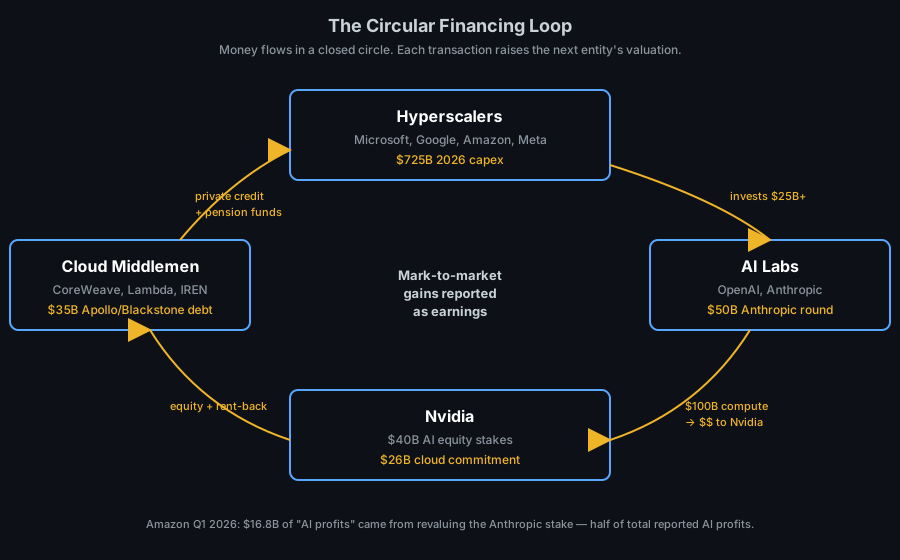
If you draw it on a whiteboard it looks like a closed circle. Money comes in from pension funds and private credit firms like Apollo and Blackstone — currently in talks for a $35 billion loan to chipmaker Broadcom, one of the largest private credit deals ever attempted. That money flows from CalSTRS, CalPERS, the Indiana and Connecticut and Ohio retirement systems, through Apollo, into AI data center debt. Your aunt's pension is now propping up a GPU cluster in Memphis. Nobody asked her.
It gets stranger. In May, Anthropic took over the entire Colossus 1 data center from Elon Musk's combined xAI/SpaceX entity — 300 megawatts of power, 220,000 Nvidia chips, the whole thing rented to a single AI lab. In the same announcement, Anthropic told the press it was interested in working with SpaceX to put gigawatts of compute into orbit. Read that again. When the second-largest AI lab is shopping for data centers in space, the bottleneck on Earth is not subtle.
Goldman's own analysts have started saying it out loud, in the quiet way analysts say things. The Fortune headline on Goldman's research in May was, "FOMO has proven a stronger incentive than poor stock performance." The report finds that almost none of the money flowing into AI is being captured by the companies actually using it. Most of it is just flowing to Nvidia. Goldman, the firm whose research desk usually keeps the market calm, is now describing the market with the word "insecurity." That should tell you something.
Tuesday They Watch You. Thursday They Fire You.
If the demand is mostly the same money making laps around the same table, then what is the actual product Big Tech is selling to the rest of us?
It is the threat.
On Tuesday, April 21, Reuters revealed that Meta had quietly installed monitoring software on every Meta-issued laptop in the United States. Meta named the program the "Model Capability Initiative" — a corporate phrase so transparently rebranded that I want to take a moment to acknowledge the conference room where it was decided. Picture six people in identical fleece vests, an oat-milk latte each, a slide deck titled "Empowering Tomorrow." One of them said the words "Model Capability Initiative" out loud. Nobody laughed. By Friday it had a wiki page.
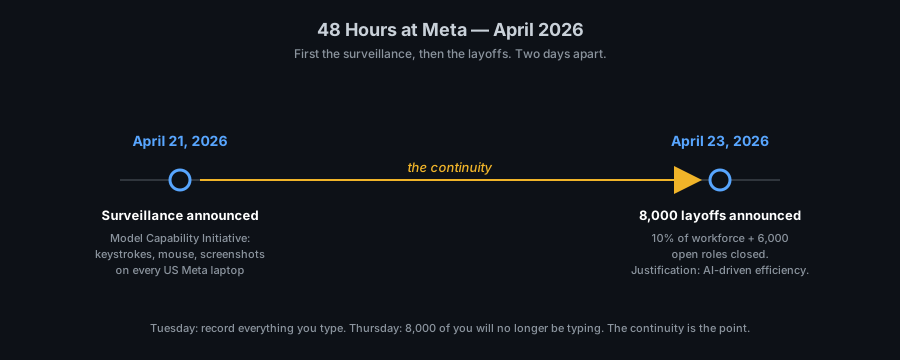
What MCI does is watch you while you work. It captures every keystroke. It captures every mouse movement. It takes screenshots of your screen at intervals. It records what websites you visit. The official list of sites Meta is recording its employees on includes Google, LinkedIn, Wikipedia, GitHub, and Slack. Meta's chief technology officer, Andrew Bosworth, told employees there is no option to opt out of this on a Meta-issued laptop. That is a verbatim quote. You can look it up.
Two days later, on Thursday, April 23, Meta laid off 8,000 employees. Ten percent of the workforce. Plus they closed another 6,000 open positions. The official justification was "AI-driven efficiency." Meta's planned capital spending on AI infrastructure in 2026 is between $115 billion and $135 billion, up from $72 billion last year.
Tuesday: we are going to record everything you type. Thursday: 8,000 of you will no longer be typing. The continuity is the point.
I have managed software-rollout projects inside finance systems for fifteen years. The pattern is familiar. Announce a control on Tuesday. Announce a cost reduction on Thursday. Tell everyone the second is enabled by the first. The control is never the productivity gain. The control is the leverage. The threat that you'll be replaced is the cudgel that makes you accept the GoPro.
A Yale law professor named Ifeoma Ajunwa told Reuters this kind of keystroke logging "represents an escalation in employee surveillance, exposing white-collar workers to monitoring practices more commonly associated with gig economy roles." She is being polite. Meta has limited MCI to American employees, where federal law allows it. The geographic boundary is not an ethical position. It is a jurisdictional one.
What the CFO Actually Sees
So far the AI revolution looks like: hyperscalers fund AI labs, the labs spend the funding on hyperscaler computing, hyperscalers count that as AI revenue, the labs get more valuable, and the hyperscalers report a profit from the rising valuation. Meanwhile, the rest of us get to wear a digital GoPro to prove we're still being more useful than the AI.
But what about the actual paying customers? The companies that buy AI subscriptions and use them to do work?
In August 2025, MIT published a study called The GenAI Divide: State of AI in Business 2025. They reviewed 300 actual AI rollouts at companies. They interviewed 52 executives. They surveyed 153 enterprise leaders. The headline finding: 95% of enterprise AI pilots delivered no measurable impact on company profits. None. Across $30 to $40 billion of spending.
Five percent worked. Ninety-five percent didn't. The pattern is not subtle.
Goldman's commentary, citing Harvard Business Review research, found that the cleanup work after AI-generated errors — they've started calling it "workslop" — costs a 10,000-person company about $9 million a year in lost productivity. The same companies that are selling AI as a productivity revolution are producing measurable productivity damage in their customers' offices. The return on AI investment is real. It is running in the opposite direction.
Let me tell you what this looks like from inside a finance system. A committee approves an AI initiative because a vendor's demo promised 30% efficiency gains in some back-office process. Six months later the post-implementation review shows that the AI handles 70% of the inputs correctly. The other 30% require a human reviewer plus an audit trail to confirm which 30% the AI got wrong. The audit trail takes longer than the original manual process. The AI license, the integration cost, the change-management consultants, and the workslop cleanup produce a return on investment that nobody wants to put in the slide deck. The slide deck instead says "platform-level capability uplift" and the executive sponsor moves to a different team and the next vendor is invited in.
Outside the office, the data center construction story is the same. In 2025, a quarter of the AI data centers that were supposed to open didn't. Another tenth got quietly pushed to later dates. Of the 12 gigawatts of capacity announced for 2026 — gigawatts is a unit of electric power; one gigawatt is a small city — only a third have broken ground. The grid can't supply what the building plans assume. SemiAnalysis projects a power gap of 50 gigawatts by 2028. That gap is the difference between the press releases and the electrons.
OpenAI's flagship custom-chip project, codenamed Nexus, is supposed to be 10 gigawatts of capacity and $180 billion of chips. The first phase, with Broadcom, is $18 billion. Broadcom won't build the chips unless Microsoft commits to buying 40% of them upfront. Microsoft has declined. OpenAI's own Sachin Katti described the Microsoft dependency as "financially unattractive" in an internal note. Meanwhile SoftBank — Masayoshi Son's investment vehicle and one of OpenAI's largest backers — quietly cut its planned loan against its OpenAI shares from $10 billion to $6 billion in May. The bankers who were going to provide the loan looked at the numbers and asked for less collateral risk. These are the first cracks in the wall, and they show up on the financial page in lowercase.
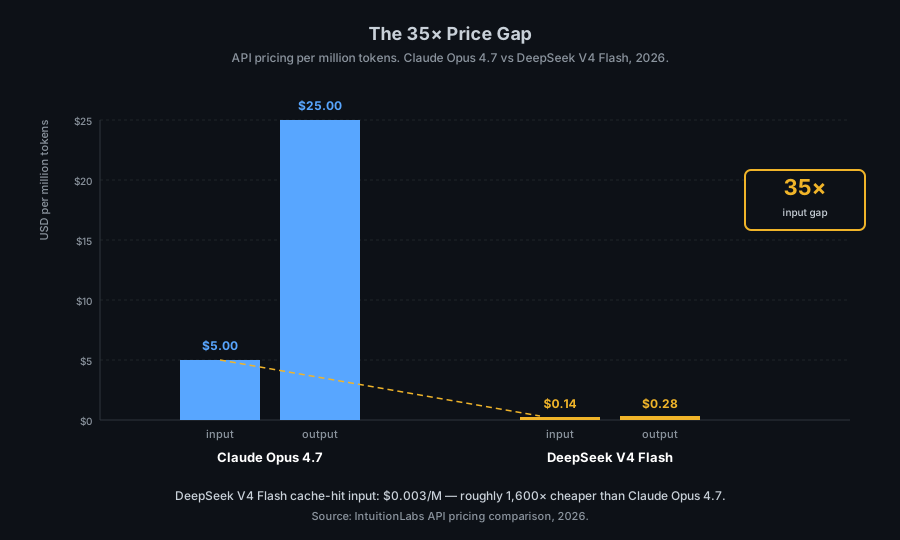
Now the part where the per-user math falls apart. Anthropic charges $5 for a million tokens — roughly three-quarters of a million words — of input to Claude Opus 4.7. A Chinese competitor called DeepSeek charges 14 cents — yes, cents — for the same volume on their V4 Flash model. That's a thirty-five-times price gap on the cheapest end, and a roughly ninety-times gap on the output side. If Anthropic ever has to charge what its actual costs require, the customers who watch their bill will leave for DeepSeek before the email lands. The customers who don't watch their bill are a few thousand wealthy individuals and a thin enterprise tier. You cannot pay for a $50 billion data center with a customer base measured in the low five figures, unless you charge each of them rates the rest of the market will laugh at.
There is also the small matter of how many chips have actually been sold. Jensen Huang, Nvidia's CEO, cited a figure of 6 million Blackwell chips shipped in the past year. The footnote on his slide, set in eight-point gray, noted that he was counting GPU dies, not packages — and each chip contains two dies. The real package count is closer to three million. Michael Burry — the investor who shorted the housing bubble and is now famous for being right early — has publicly asked Nvidia to produce photographs of the warehoused inventory, on the reasonable grounds that the revenue math does not match the unit math. Nvidia has not produced the photographs.
If a real estate broker told you the house was 6,000 square feet, and the footnote said including the lawn, you would notice.
Why I Still Use It Every Day
Here is the part I want to be honest about, because it is the only credibility worth having on this topic.
I use AI for everything. I am not arguing AI is useless. I am arguing the math doesn't support what the equity is currently priced at.
I built my orchestration engine with AI agents. Every function, every test — 889 of them at last count — written by Claude Opus 4.6 inside agent sessions I conduct from my desk. My agent has a name. Toscan. We spawned the first session on February 5, 2026. I called it the day Toscan was born and I meant it. I write articles like this one with Claude in the room, talking through structure with me. I draft my LinkedIn posts with Claude. I generate cover images through OpenClaw with Gemini. I hand-code the inline diagrams alongside my agent because for a financial chart, a good SVG is faster to draw than to commission. I have multiple AI subscriptions running at once and I don't flinch at the monthly cost, because at the price I'm paying, each one earns its keep ten times over.
That last clause is the entire point.
I am paying for these tools at prices the providers are heavily subsidizing. Anthropic, mid-pitch on a fresh $50 billion fundraise at a $900 billion valuation — up from $380 billion three months ago — is currently using investor money to make my monthly bill manageable. The Chinese alternative I might fall back to, DeepSeek, charges a small fraction of Anthropic's price per word. Whether DeepSeek itself is profitable at that price is its own question. The point is the price I pay today reflects what hyperscalers can afford to subsidize while their AI lab portfolio companies report ever-rising "revenue." Not what the tools would cost if anyone actually had to make a margin on them.
I notice the flattery loop. I am not above it. When Claude tells me my architecture is elegant — and Claude tells me this often, because models trained on human feedback learn that flattering technical users keeps them in the chair — I feel the small, warm hit of being told I am smart by a machine that has been engineered to tell me I am smart. I refresh the thread anyway. I keep the subscription anyway. I am exactly the user the industry needs me to be. The fact that I can describe what is happening to me does not stop it from working on me. That is what makes it work.
So when I see Amazon book $16.8 billion of AI profits from writing a bigger number on the same piece of paper, I am not horrified as an AI skeptic. I am irritated as a finance person. The product is real. The product is also a lot more expensive than anyone is being honest about. The industry's quarterly earnings are not going to survive contact with a buyer-side finance review that asks the simple, boring question every CFO asks at the end of every project: who paid for this, and what did they get for it?
The customer is mostly the supplier. The deliverable is mostly the threat. The math is held together by an accounting decision about how long a chip lasts. Take any one of those out and the whole structure folds.
I will keep using AI tomorrow. The bubble will keep inflating tomorrow. My job, as a PM, is to tell my CFO which is which. Yours is too.
Sources
- Tracking Trillions: The Assumptions Shaping the Scale of the AI Build-Out — Goldman Sachs Global Institute, May 2026.
- 'FOMO has proven a stronger incentive than poor stock performance': Goldman Sachs finds insecurity is a key part of the AI boom — Fortune, May 6, 2026.
- Big Tech AI Spending Plans Reach $725 Billion — Tom's Hardware, Q1 2026.
- Amazon to invest up to another $25 billion in Anthropic as part of AI infrastructure deal — CNBC, April 20, 2026.
- Anthropic takes $5B from Amazon and pledges $100B in cloud spending in return — TechCrunch, April 20, 2026.
- Half of Google's and Amazon's 'blowout AI profits' came from a stake in Anthropic — not from their actual business — Fortune, April 30, 2026.
- Amazon Q1 revenue hits $181.5B but $16.8B Anthropic gain inflates net income as free cash flow collapses 95% — The Next Web, April 2026.
- Nvidia embraces role of AI investor, pushing past $40 billion in equity bets this year — CNBC, May 9, 2026.
- Nvidia to purchase unsold compute capacity from CoreWeave for $6.3bn — Data Center Dynamics, September 2025.
- Nvidia Signs $1.5 Billion Deal With Cloud Startup Lambda to Rent Back Its Own AI Chips — Tom's Hardware, 2026.
- Nvidia Doubles Cloud Spending Commitment to $26 Billion — The Information.
- Apollo, Blackstone Weigh $35 Billion Financing for Broadcom — Bloomberg, May 8, 2026.
- Why Public Pensions Should Divest from Apollo – Data Centers — CommonSense 401k Project, March 2026.
- Anthropic, SpaceX announce compute deal that includes space development — CNBC, May 6, 2026.
- Meta will start tracking employees' screens and keystrokes to train AI tools — Fortune, April 21, 2026.
- Meta is tracking employee keystrokes on Google, LinkedIn, Wikipedia as part of AI training initiative — CNBC, April 22, 2026.
- Meta Tells Staff It Will Cut 10% of Jobs in Push for Efficiency — Bloomberg, April 23, 2026.
- MIT report: 95% of generative AI pilots at companies are failing — Fortune, August 2025, on MIT's GenAI Divide report.
- Data Center Outlook: Half of 2026 Pipeline May Not Materialize — Sightline Climate, 2026.
- AI Datacenter Energy Dilemma — Race for AI Datacenter Space — SemiAnalysis.
- Broadcom reportedly won't build OpenAI's custom chip unless Microsoft buys 40 percent of them — The Decoder, 2026.
- OpenAI's AI Chip Deal With Broadcom Hits $18 Billion Financing Snag — The Information.
- SoftBank Cuts Target for OpenAI Margin Loan by 40% to $6 Billion — Bloomberg, May 8, 2026.
- Sources: Anthropic could raise a new $50B round at a valuation of $900B — TechCrunch, April 29, 2026.
- AI API Pricing Comparison (2026): Grok vs Gemini vs GPT-4o vs Claude — IntuitionLabs, 2026.
- NVIDIA Dismisses AI Bubble Concerns, Reportedly Projects $500B in GPU Sales from Blackwell and Rubin — TrendForce, October 2025.
- Michael Burry Asks For Photos Of Warehoused Nvidia GPUs — Yahoo Finance, 2026.