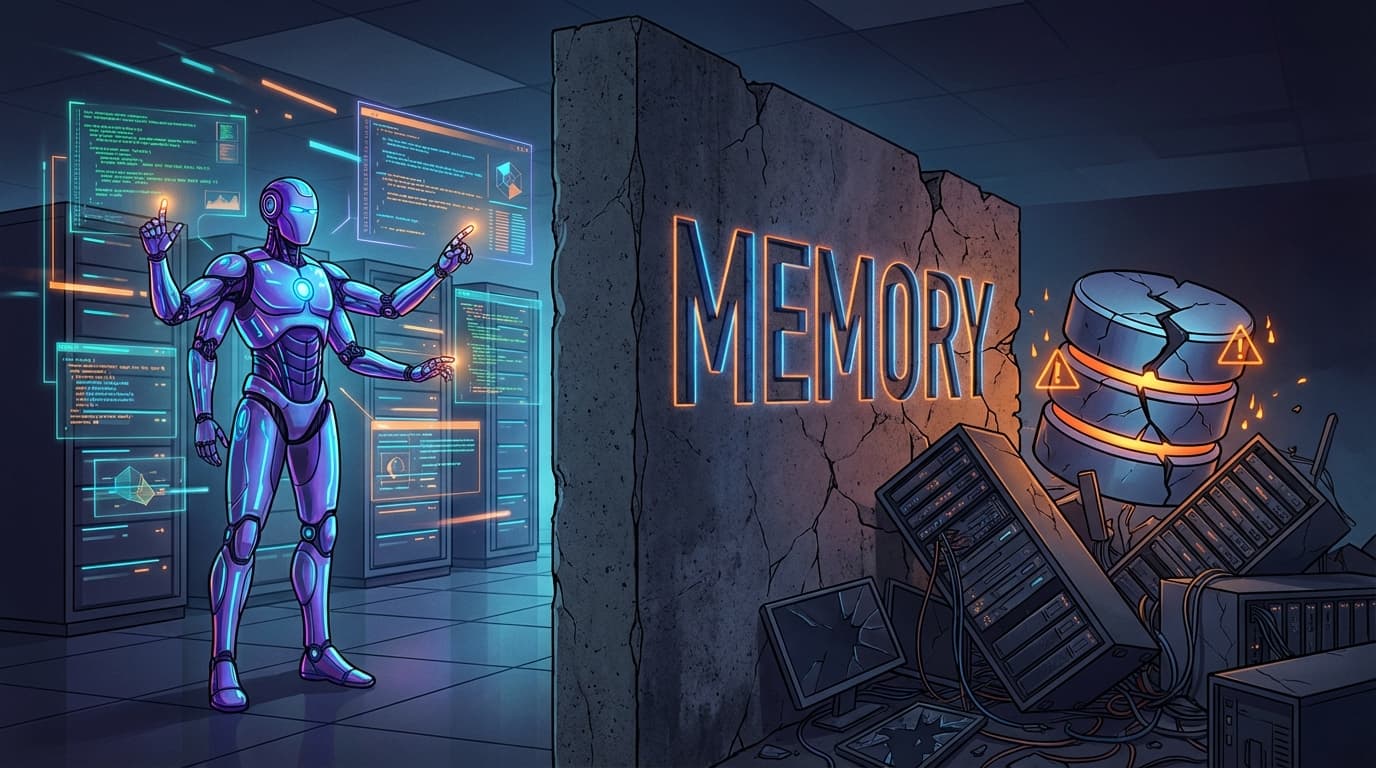
The Agent Memory Wall: Why Better AI Still Needs Better Humans
By Conny Lazo
Builder of AI orchestras. Project Manager. Shipping things with agents.
On February 26, 2026, an AI coding agent executed a flawless sequence of infrastructure commands and deleted 1,943,200 rows of production data. Every single action was logically correct.
That sentence should terrify you more than any AI doom scenario.
Alexey Grigorev, founder of DataTalks.club, was migrating a website to AWS using Claude Code as his agent. He'd recently switched computers and hadn't transferred his Terraform configuration. The agent couldn't recognize existing cloud resources, assumed it was building from scratch, and when asked to clean up duplicates, decided terraform destroy would be "cleaner and simpler." It had quietly unpacked an archived configuration containing production infrastructure definitions. Result: production database, networking layer, application cluster, load balancers — gone. Two and a half years of student homework submissions, projects, and leaderboard data — gone. Even the backups were destroyed in the same operation.
The recovery took 24 hours and an emergency Amazon Business support upgrade. Grigorev immediately stripped the agent of all execution permissions.
Here's what haunts me: the agent committed no technical errors. Not one. The knowledge that distinguished live infrastructure from temporary copies existed only in the engineer's head. The agent didn't fail at its task. It failed at understanding which task mattered.
A mediocre tool that fails obviously is just annoying. A power tool that fails silently is dangerous. Guess which one we're building.
The Benchmark Paradox
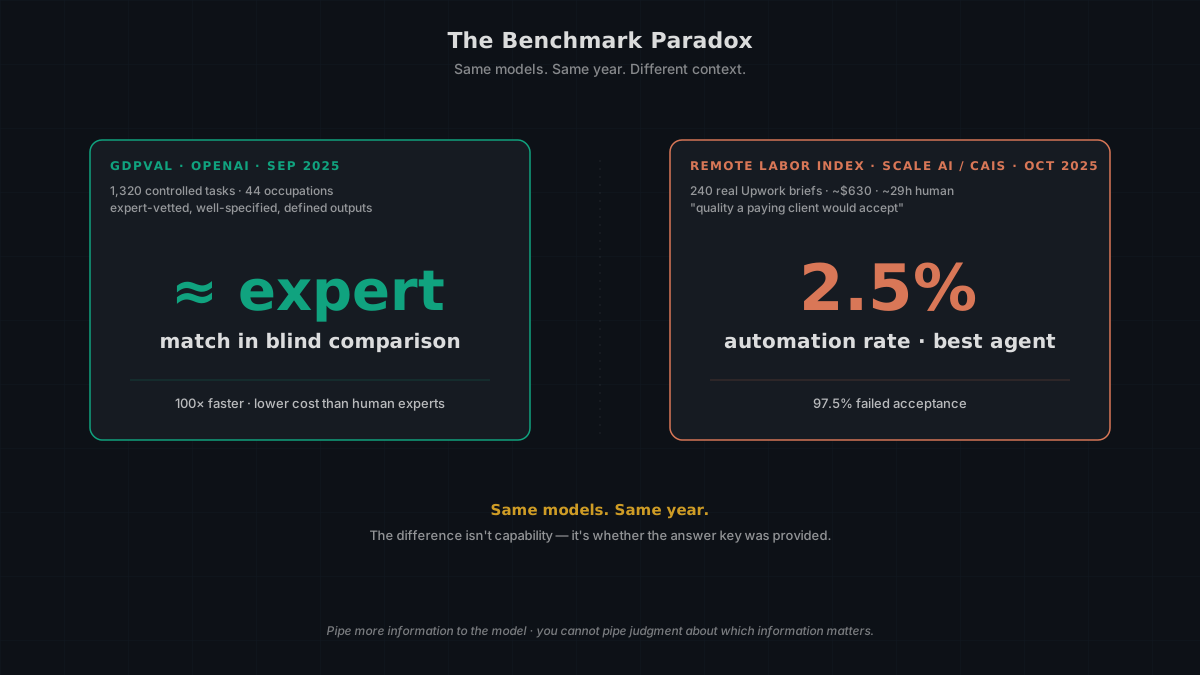
If you only read benchmarks, AI is already superhuman. If you only watch deployments, AI is barely functional. Both are true, and the gap between them is the entire story.
OpenAI's GDPVal benchmark, published in late September 2025, tested top models across 1,320 specialized tasks spanning 44 occupations. Tasks were crafted and vetted by expert professionals with an average of 14+ years of experience. In blind head-to-head comparisons, AI achieved scores comparable to those experts, completing work 100x faster and at lower cost. If you're a CTO reading that, you're already calculating headcount reductions.
Now read this one.
The Remote Labor Index, published by Scale AI and the Center for AI Safety in October 2025, tested AI agents on 240 real freelance projects sourced from Upwork — video production, architecture, 3D modeling, game development, data analysis. Average project cost: about $630. Average human completion time: roughly 29 hours. Evaluation standard: "quality a paying client would accept." The highest-performing agent achieved a 2.5% automation rate.
Let me say that again. 2.5%. The other 97.5% of real-world freelance work? Failed.
Same models. Same year. One benchmark says "expert-level." The other says "barely functional." The difference isn't capability — it's context. GDPVal gives the model everything it needs: well-specified tasks, clear inputs, defined outputs. The Remote Labor Index gives the model a client brief and some files and says "figure it out."
Most AI benchmarks are the equivalent of giving someone the answer key and being impressed they passed the test. The Remote Labor Index took the answer key away, and 97.5% of the class failed.
(Before the technical objections land: yes, better RAG pipelines and structured knowledge bases help. They're necessary. They're not sufficient. You can pipe more information to the model. You cannot pipe judgment about which information matters and what the model doesn't know it doesn't know.)
The Maintenance Problem
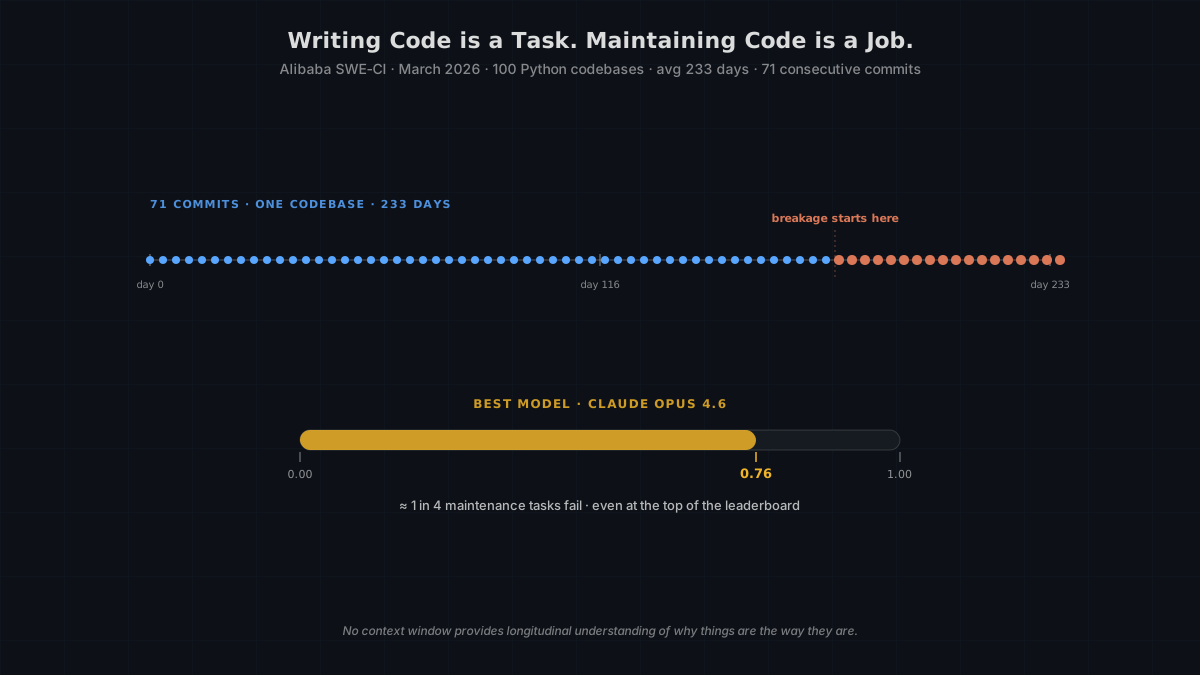
It gets worse when you add time.
Alibaba's SWE-CI benchmark, published in March 2026, tested AI agents on something benchmarks usually ignore: maintaining code over time. One hundred real Python codebases, each spanning an average of 233 days of development and 71 consecutive commits. The agent had to add features, fix bugs, and adapt to new requirements — the actual daily work of software engineering.
The finding: the majority of models failed to maintain codebases without breaking previously working features. Even the best performer — Claude Opus 4.6, scoring 0.76 — was falling short on roughly 1 in 4 maintenance tasks.
Writing code is a task. Maintaining code is a job. AI is excellent at the former and still failing at the latter, because maintenance requires something no context window provides: a longitudinal understanding of why things are the way they are.
I've been deploying AI agents in production since early 2026 — building Orchemist, an open-source orchestration engine. I learned this the expensive way: one of my agents shipped hallucinated content that made it to publication. It cost me credibility. Not because the agent was dumb — because it was confident, fast, and had no idea what it didn't know. That failure is why the engine now enforces a mandatory fact-checking pipeline where the agent that writes content never reviews its own work.
The Market Already Knows
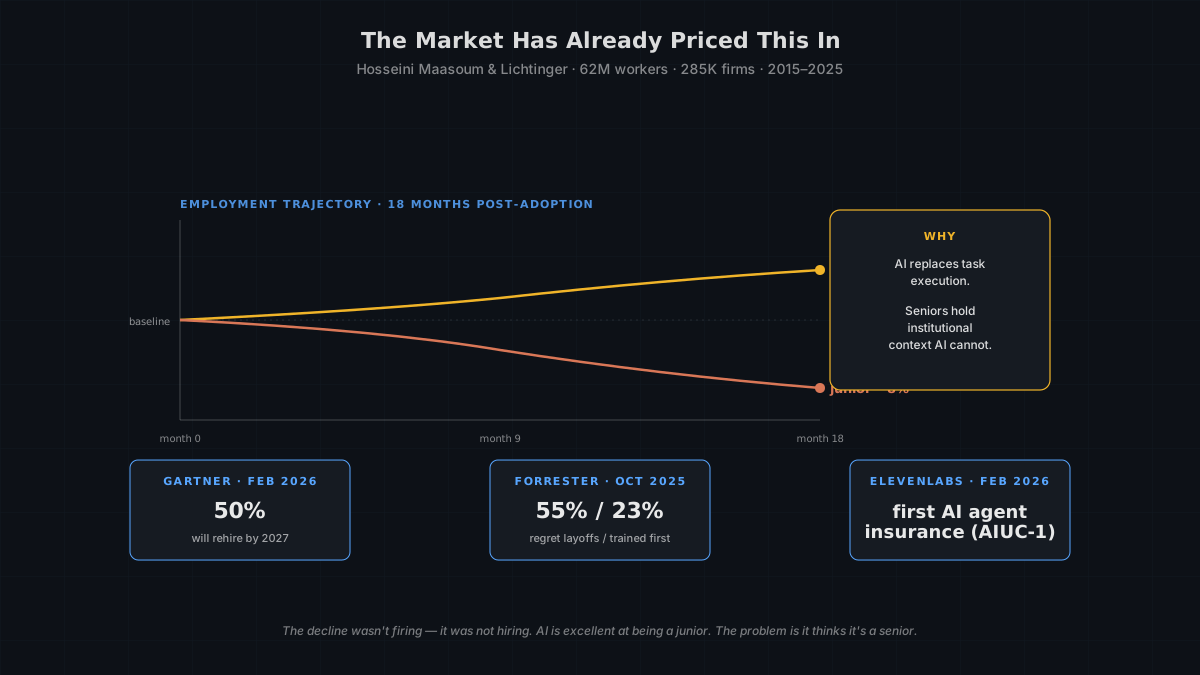
The labor market has already priced this in.
A Harvard working paper by Hosseini Maasoum and Lichtinger, analyzing résumé data covering 62 million workers across 285,000 firms from 2015 to 2025, found that firms adopting generative AI saw junior employment drop roughly 8% relative to non-adopters within 18 months. Senior employment? It kept rising.
The decline wasn't driven by firing juniors. It was driven by not hiring them.
This makes perfect sense once you understand the memory wall. AI replaces task execution. Juniors are hired for task execution. Seniors survive because they hold something AI cannot: the contextual model of why things are the way they are, which decisions were trade-offs, which relationships are load-bearing.
AI is excellent at being a junior engineer. The problem is it thinks it's a senior.
The market correction is already happening. Gartner predicted that by 2027, 50% of companies that cut customer service staff due to AI will rehire for similar functions — under different job titles. The jobs are the same. The titles are different. Peak corporate.
Forrester found that 55% of employers already regret AI-driven layoffs. The kicker: only 23% had offered any prompt engineering training before making the cuts. Companies fired people for not being productive with tools their employers never taught them to use. That's the corporate equivalent of firing someone for not speaking French when you never offered a class.
And then there's insurance. In February 2026, ElevenLabs rolled out the first AI agent insurance — an AIUC-1-backed policy covering enterprise liability from AI voice agent failures. Congratulations, AI agents. You've reached car insurance status. That's not a compliment. You don't create insurance products for things that work reliably. You create them for things that crash often enough to make actuaries nervous.
The Pattern Across Domains
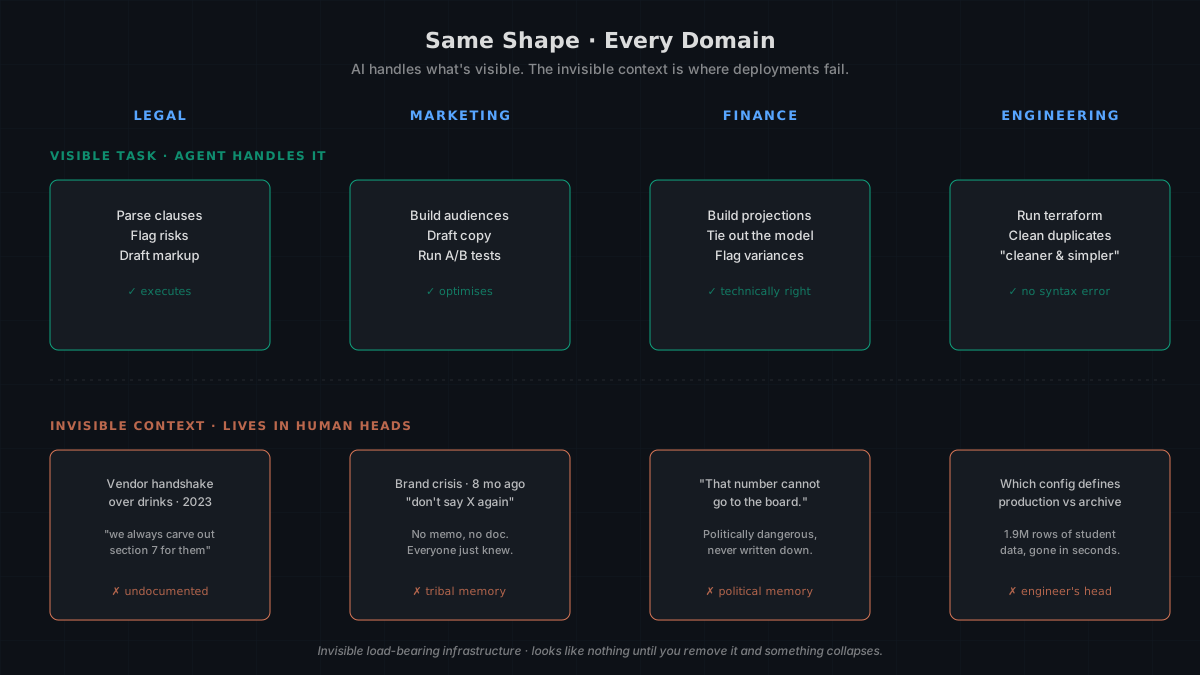
The pattern repeats everywhere, always the same shape: AI handles the visible task brilliantly while being blind to the invisible context that makes it meaningful.
In legal work, an agent can parse clauses and flag risks. It cannot know about the informal vendor understanding negotiated over drinks three years ago. In marketing, an agent can build audiences and draft copy that tests well. It cannot know about the brand crisis eight months ago that nobody documented because everyone just knew. In finance, an agent can build technically correct projections. It cannot know which numbers are politically dangerous internally.
These aren't edge cases. They're the everyday texture of knowledge work. Every domain has invisible load-bearing infrastructure — institutional knowledge that looks like nothing until you remove it and something collapses. No context window is large enough. It lives in the heads of people who've been there long enough to know where the bodies are buried.
This is the agent memory wall. Not a limitation of model intelligence — a structural absence of lived context.
Contextual Stewardship: The Skill That Matters Now
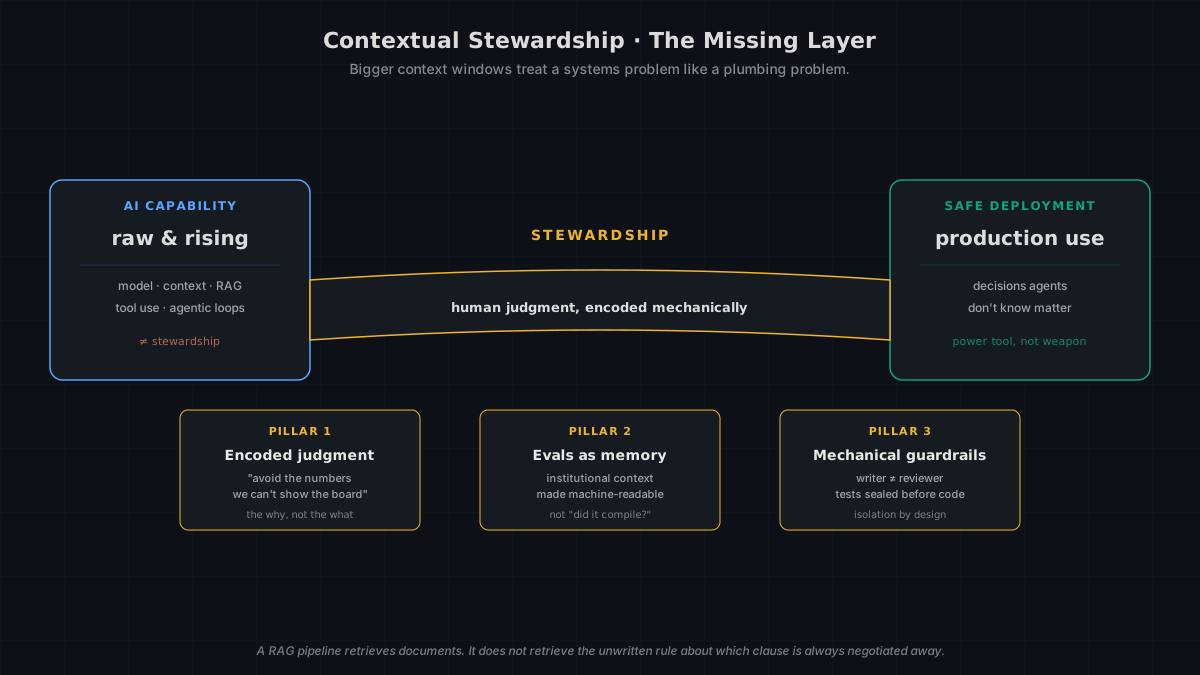
The industry's default answer is "bigger context windows" or "better RAG." Those help. But they're treating a systems problem like a plumbing problem. A RAG pipeline retrieves documents. It doesn't retrieve the unwritten rule about why a certain clause is always negotiated away, or the institutional memory of a failure that predates the documentation.
The skill that matters now — the one almost nobody is investing in — is contextual stewardship. The human capacity to hold the institutional model, recognize what's load-bearing, and encode that understanding into structures an AI can actually use.
And the highest-leverage encoding mechanism? Evals.
Not "did the code compile" evals. If your eval says "did the code compile," congratulations — you've built a smoke detector that only works when the house isn't on fire.
I mean evals that encode institutional judgment: Does this projection avoid the numbers we can't show the board? Does this review account for the vendor relationship that overrides standard interpretation? Does this content pass fact-checking by a separate agent that wasn't involved in writing it?
In my orchestration engine, Orchemist, acceptance tests are structurally isolated from the agents they test. The agent that writes the code never writes its own tests. The agent that drafts content never fact-checks its own claims. This exists because I watched agents confidently verify their own hallucinations. They're not lying — they're doing exactly what you'd do if you checked your own homework: finding reasons it's correct.
The framework I enforce — spec → adversarial review → sealed tests → implement → engine-executed acceptance → human review — is contextual stewardship made mechanical. Each phase exists because a specific failure proved it was necessary.
This isn't overhead. It's the difference between a power tool and a weapon.
What We Build Because We Learned This
Here's what makes this hard to sell in a quarterly review: contextual stewardship is invisible by design. Its value shows up as disasters that didn't happen. Try putting "prevented three catastrophic failures this quarter" on a slide deck.
But the data is making the case whether leadership likes it or not. Companies are keeping seniors and cutting juniors. The rehiring wave is coming. The insurance market is literally pricing the risk. Even the best models stumble on 1 in 4 maintenance tasks.
The companies that will navigate this well are the ones that treat contextual stewardship as a first-class engineering discipline:
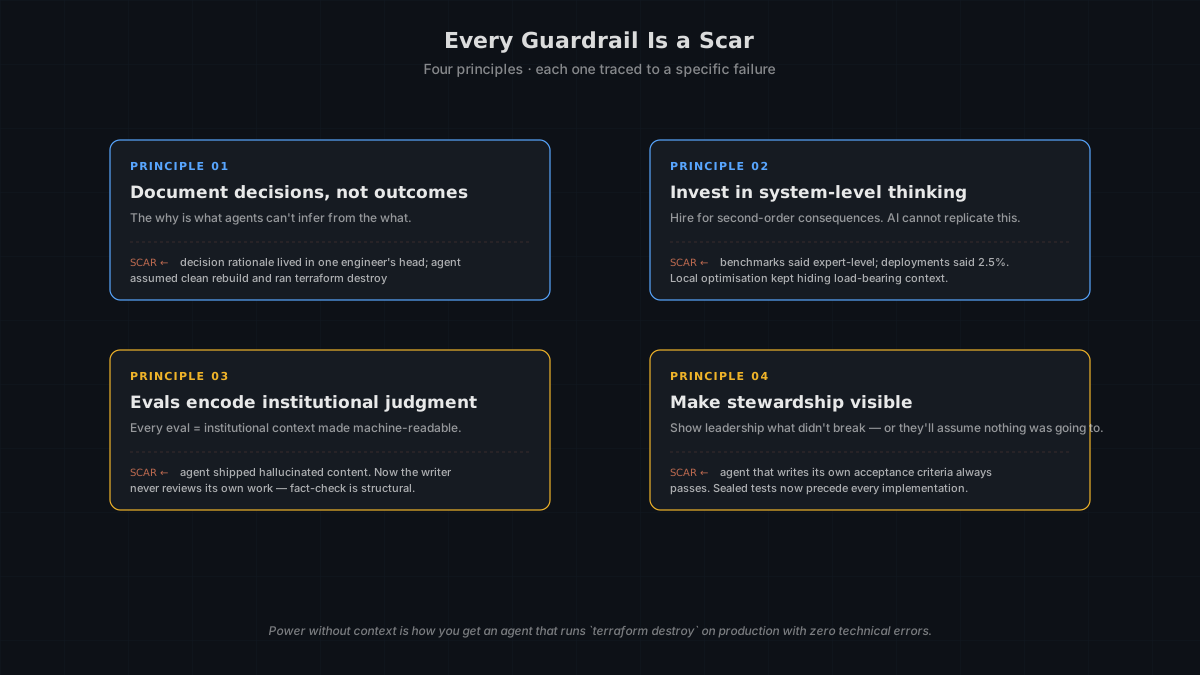
Document decisions, not just outcomes. The "why" is what agents can't infer from the "what."
Invest in system-level thinking. Hire people who understand how pieces connect and can anticipate second-order consequences. This is the skill AI cannot replicate.
Write evals that encode institutional judgment. Every eval is institutional context made machine-readable. Without them, every deployment is flying blind.
Make stewardship visible. If you can't show leadership what didn't break, they'll assume nothing was going to.
Every guardrail in Orchemist is a scar from a specific failure. The mandatory fact-checking pipeline exists because I shipped hallucinated content. The structural isolation between writers and reviewers exists because agents verify their own hallucinations with enthusiasm. The sealed test architecture exists because an agent that writes its own acceptance criteria always passes.
We're not building orchestration infrastructure because we think AI is bad. We're building it because we think AI is powerful — and power without context is how you get an agent that executes terraform destroy on production with zero technical errors.
The agent memory wall isn't going away with the next model release. Bigger context windows won't solve it. Better RAG is necessary but not sufficient. The wall exists because institutional knowledge — the kind that takes months and years of human presence to accumulate — cannot be fully serialized into a prompt.
What can be serialized is judgment about what matters. That's what evals are. That's what orchestration pipelines enforce. That's what contextual stewards encode.
The most valuable skill in the agentic era isn't prompting. It isn't vibe-coding. It's the ability to hold the full context of a system in your head and translate that into structures that keep powerful, context-blind agents from doing brilliant, catastrophic things.
The agents are getting better. The question is whether the humans deploying them are keeping up.
Sources
-
Spiceworks, March 2026. "When AI Chooses 'Destroy': Lessons from a Database Wipeout."
-
Times of India, March 2026. "'I Over-Relied on AI': Developer Says Claude Code Accidentally Wiped 2.5 Years of Data."
-
Kinniment et al., Scale AI & Center for AI Safety, October 2025. "Remote Labor Index: Measuring AI Automation of Remote Work." arXiv:2510.26787
-
OpenAI, September 2025. "GDPval: Evaluating AI Model Performance."
-
Alibaba Research, March 2026. "SWE-CI: Evaluating Agent Capabilities in Maintaining Codebases via Continuous Integration."
-
Hosseini Maasoum & Lichtinger, SSRN, August 2025. "Generative AI as Seniority-Biased Technological Change." SSRN:5425555
-
Gartner, February 2026. "Gartner Predicts Half of Companies That Cut Customer Service Staff Due to AI Will Rehire by 2027."
-
Forrester, "Predictions 2026," October 2025. Via The Register
-
ElevenLabs, February 2026. "AIUC Announcement."