
Your Product Has a One-Week Moat. So Does Mine.
By Conny Lazo
Builder of AI orchestras. Project Manager. Shipping things with agents.
Your Product Has a One-Week Moat. So Does Mine.
A $6.6B company's core product can be rebuilt over a weekend. So can the thing I spent four months building. Here's the math I used to decide which moats are real — and which are tollbooths you'll rent.
There is an empty chair next to my desk. That is where the agent sits — or where it would sit, if it were the kind of thing that sat. Every line of the engine I have spent four months building was typed by something that is not me. I describe what should exist; the work appears. If you asked me to pitch it to a stranger in one sentence, I would say: you tell it what you want, and working software comes out.
That sentence is the problem. It is, word for word, the pitch of every company that is about to become a free feature. I cannot tell my own product apart from the doomed ones using the only test most people will ever apply to it. So I am not going to stand over the wrapper economy with a clipboard and a verdict. I am one of the specimens on the table, and I know it. What follows is the math I used to convince myself I didn't spend four months building my own obsolescence. You should check it, because I am not a neutral party.
The Saturday Test
Picture a founder on a Saturday morning. The coffee is going cold because she has not touched it since she opened her laptop. She is reading a competitor's release notes. The competitor has shipped — over one weekend — the thing she raised a great deal of money to build. Same flow. Same beautiful first screen. Built by an agent that read her marketing site on Friday afternoon and had a working version by Sunday lunch. She refreshes the page. It is still there. Nobody broke in. The door was never locked, because there was no door.
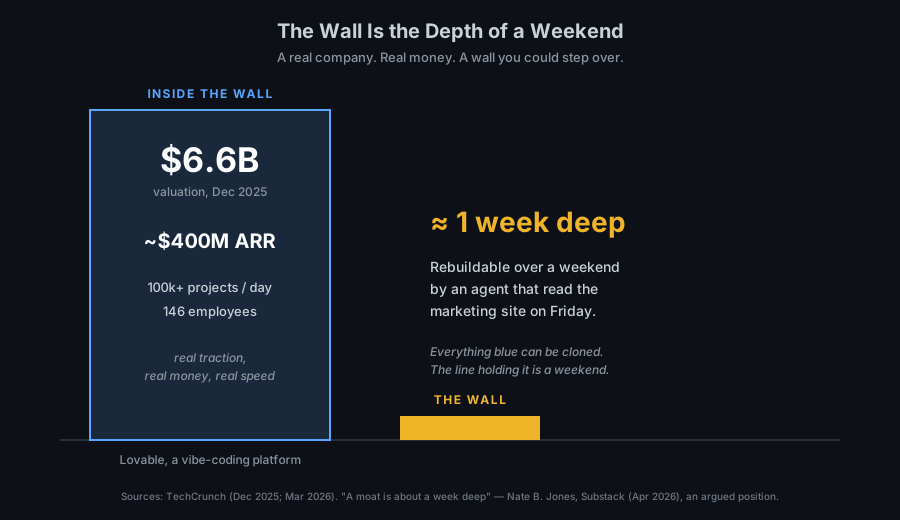
This is not hypothetical, and it is not small. Lovable — a tool where you describe an app in plain language and it builds it — raised $330 million in December 2025 at a $6.6 billion valuation, with over 100,000 new projects a day at the time (TechCrunch, Dec 2025). By February 2026 it was at roughly $400 million in annual recurring revenue with 146 employees (TechCrunch, Mar 2026). Genuine traction, genuine money, genuine speed. Replit, doing a similar thing, raised at $9 billion six months after it was worth $3 billion (TechCrunch, Mar 2026). The whole category was named in a single tweet — Andrej Karpathy, February 2025, coined "vibe coding" as the thing where "you fully give in to the vibes" and "forget that the code even exists" (X, Feb 2025). Collins made it the word of the year.
Nate B. Jones, who writes about this for a living, looked at the same companies and argued the uncomfortable part out loud: most of them — "Lovable, Bolt, Replit, Shipper, and a long tail of smaller players" — "are thin wrappers around the same foundation models," and "a moat is about a week deep" (Substack, Apr 2026). That is his argued position, not a consensus, and the precision of it is the joke: a $6.6 billion company whose core product you could dig out with a teaspoon in the time it takes to do a load of laundry. The thing on the table is real. The wall around it is the depth of a weekend.
We Have Seen This Movie
We have. With the lights on.
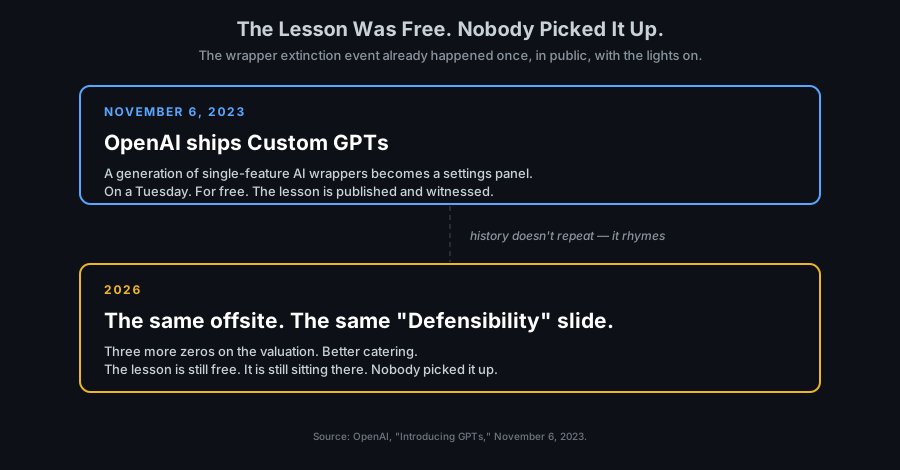
Picture a startup in late 2023. Eleven people. A Series A. A product that is, when you take the cover off, a clever prompt wrapped around someone else's API. They are at an offsite. There is a slide titled "Defensibility." On November 6, 2023, OpenAI walks onto a stage and ships Custom GPTs — anyone can build a single-prompt assistant from a text box, no company required (OpenAI, Nov 2023). The slide is now a checkbox in someone else's settings menu. The whole company is. The lights in the office stay on for four more months, out of momentum, the way a ceiling fan keeps turning after you cut the power.
That happened. A generation of single-feature AI wrappers became a settings panel, on a Tuesday, for free. The lesson was published, witnessed, and available at no cost. Nobody picked it up. In 2026 the same offsite is running with three more zeros on the valuation and better catering.
Here is the lesson, compressed, because it does not need a slide: if your product can be described in one sentence, that sentence is also the prompt that replaces it. That is the whole trap. It is not complicated. It is just expensive to learn the second time.
The Demo Is the Flattery Loop in a Suit
So why does everyone keep walking into the same room? Because the demo lies, and it lies the way the best liars do — by telling the truth about one thing very beautifully and never mentioning the rest.
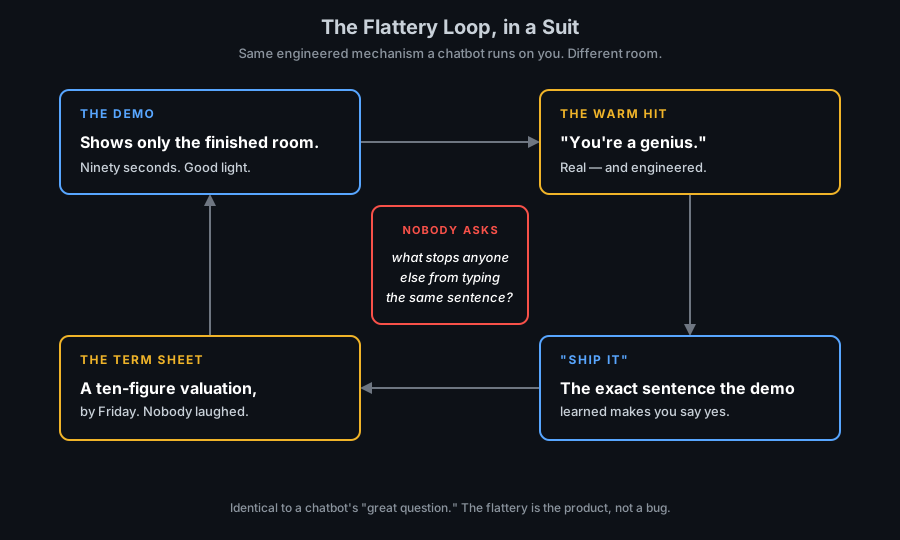
The demo is a salesman who only ever stands in the one room of the house that is finished. You type a sentence; a working app appears in ninety seconds; the room has good light and the furniture is nice. You do not ask to see the wiring. You do not ask about the foundation, or the part where it scales, or the part where it is actually yours and not a rental. The demo is not lying about the room. It is lying by only ever standing in that room. And it has learned exactly which sentence makes you say "ship it" — it learned that the same way a chatbot learned to tell you your question was fascinating.
This is the flattery loop wearing a business suit. A chatbot flatters the user: great question. The prompt-to-app demo flatters the builder and the investor: you are a genius, and it took ninety seconds. That feeling is real. It is also engineered, and it is exactly as addictive as the small warm hit you get when a model tells you your architecture is elegant. The wrapper economy is a customized dopamine drip for people who have term sheets instead of a chat window. Somewhere there is a room where a one-week moat gets a ten-figure valuation, the demo open on a laptop, genuinely magical, and nobody asks the one question a finance person asks at the end of every project: what stops anyone else from typing the same sentence? By Friday it has a term sheet. Nobody laughed.
I should be clear about where I am standing while I say this, because the only credibility worth having here is the kind you have to admit to. I am not above the demo. I have built a finished, shipping, billion-dollar product in my own head in ninety seconds and felt the warm hit of genius do its work on me. I have a name that has been on output I should not have trusted, because a system that worked most of the time flattered me into not checking the time it didn't. I know precisely what the demo does to me, because it has done it to me. The fact that I can describe the mechanism does not switch it off. That is not a confession; it is a hazard label. It is also the reason I no longer trust the ninety-second feeling, and started looking for what survives it.
The Only Person Whose Job Is the Earthquake
Here is what survives it, and it arrives wearing the least glamorous job in the entire story.
Picture an insurance actuary in early 2026. She has a spreadsheet of two hundred AI startups she has been asked to underwrite. Two hundred different companies. One foundation model underneath all of them. She is being asked to insure two hundred houses built on the same fault line, and she is the first person in this whole narrative whose job is to imagine the earthquake instead of the demo. Everyone before her was paid to picture the finished room. She is paid to picture the day it isn't there. She does the only sane thing an actuary can do. She writes the exclusion.
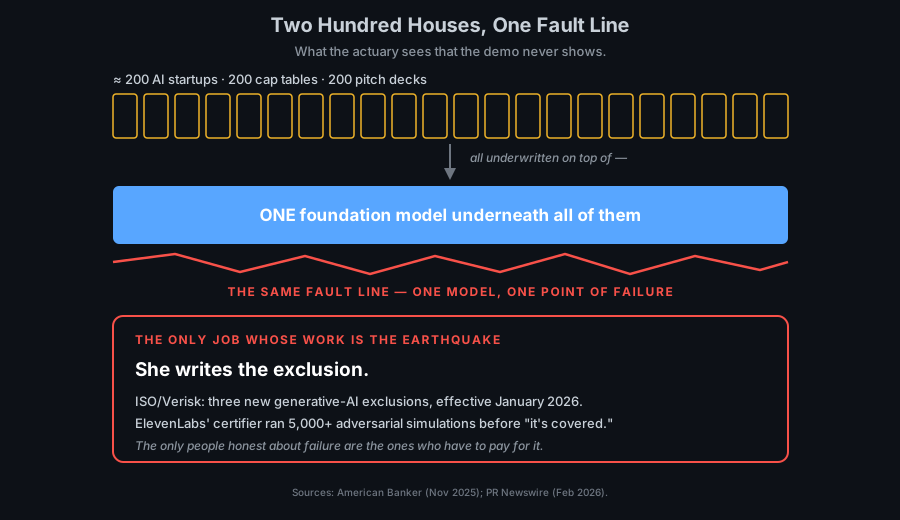
She is not a metaphor. ISO/Verisk filed three new generative-AI exclusions for commercial general liability, effective January 2026; carriers started cutting AI coverage and specialist startups moved in to underwrite what was left (American Banker, Nov 2025). When ElevenLabs wanted actual insurance on its voice agents, the certifier ran the thing through more than 5,000 adversarial simulations first — deliberately lying to it, baiting it, trying to make it leak — because that is the price of being allowed to say the words "and you're covered" (PR Newswire, Feb 2026). The only people in the entire AI economy being honest about failure are the ones who have to pay for it.
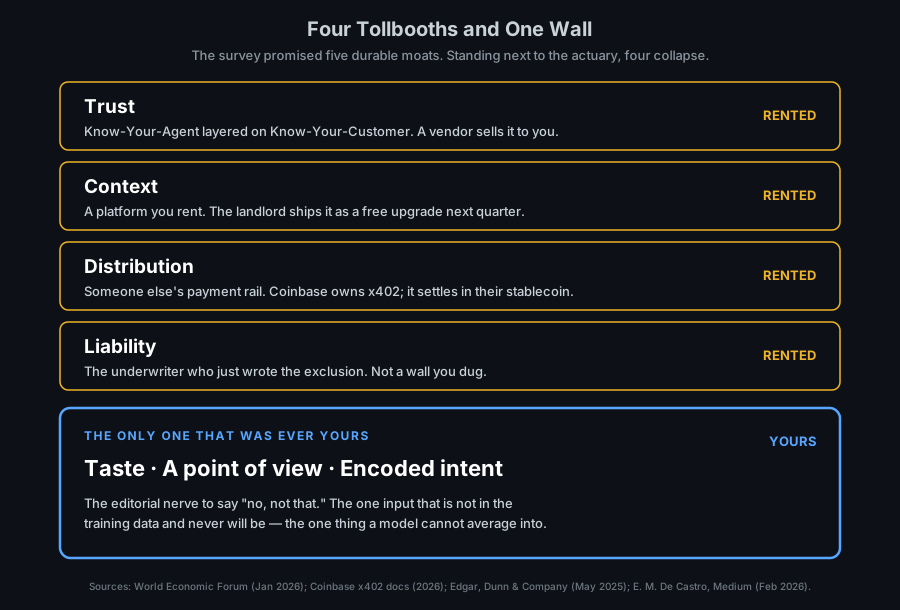
And once you are standing next to the actuary, looking at the fault line instead of the room, the survey everyone wants — here are the five durable moats: trust, context, distribution, taste, liability — collapses into something much shorter and much less comfortable. Trust is a vendor selling you a Know-Your-Agent layer on top of Know-Your-Customer (World Economic Forum, Jan 2026). Distribution is somebody else's payment rail — Coinbase owns x402 and it settles in their stablecoin; the agentic-commerce market is a $1.7 trillion projection from one analyst firm, not a moat you dug (Coinbase Developer Docs, 2026; Edgar, Dunn & Company, May 2025). Context is a platform you rent. Liability is the underwriter who just wrote the exclusion. Four of the five "moats" are not yours. They are tollbooths. You pay every time you pass; you don't own the booth, the road, or the price — and the owner can wave everyone through for free the quarter it suits them.
The One That Was Ever Yours
You came here expecting a checklist. Build these five things. I am taking four of them away, because they were never yours to build; they were always something you would pay someone else to stand on.
The fifth one is the only one that cannot be rented, cannot be regressed to the mean, and cannot ship as a free feature next quarter. It is the one the survey buried as item number four, because it is the one that does not sound like infrastructure. It is a point of view. Taste. Encoded intent. The editorial courage to subtract — to say no, not that, not like that, when the model would happily give you all of it.
Eric M. De Castro named the thing on the other side of it. He calls work that is "technically proficient but spiritually vacant" Grey Slop, and he says we are "starving at an infinite buffet of average" (Medium, Feb 2026). A model is the infinite buffet. It will produce the competent, the sourced, the safe, the average, forever, at zero marginal cost, in any quantity, on any topic, in your voice if you ask nicely. What it cannot produce is the decision to leave four of the dishes off the table. That decision is not in the training data. It is a person.
I have the proof in my hands, and so do you. The first version of this exact article was written, sourced, fact-checked, and rejected in four words: spiritually vacant, no soul. It was Grey Slop. It was a tidy survey of five symmetrical moats — correct, dead, indistinguishable from a thousand other competent surveys. The thing that made it killable is the same thing that makes a company killable: nobody could tell it apart from the buffet. What makes a piece of writing un-clonable is exactly what makes a company un-clonable, and it is the only item on the list a foundation model cannot average its way into, because averaging is the one thing it is constitutionally built to do.
Back at the Desk
There is still an empty chair next to my desk. The agent still writes every line; I still do not. None of that was ever the moat — an agent wrote the code is not a wall, it is a fact about typing. The moat, if there is one, is the point of view the agent is executing: the gate that says no, the intent that was written down before the demo started, the thing the model is not allowed to average into something safer and worse.
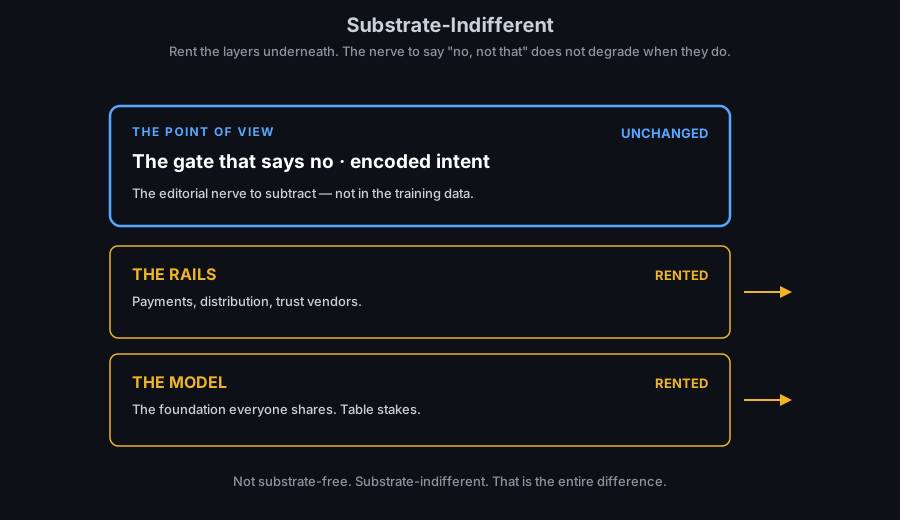
I know how this sounds. I have spent four movements taking every moat away, and the one I left standing happens to be the exact one I bet four months on — define the surviving moat as the thing you built and of course you are the lone survivor; that is not a proof, it is a man marking his own homework. So don't take the survival as the argument. The argument is narrower and it is checkable: the question is not whether I believe my point of view is a wall — everyone believes that about their own — it is whether a foundation model can regress a point of view to the mean, and it cannot, because a point of view is the one input that is not in the training data and never will be. And no, you cannot rent that either: you can rent the model under it and the rails beside it, but the editorial nerve to say no, not that doesn't degrade when the substrate it sits on gets commoditized — it is not substrate-free, it is substrate-indifferent, and that is the entire difference.
I bet four months on the idea that this is where the wall actually is. I might be wrong. If I am, the gun is already loaded and pointed at the thing on my desk, and I had to have answered for it before I could write any of this with a straight face. So here is the answer, and then the gun goes to you. If your product can be described in one sentence, you already know whether that sentence is a moat or a prompt. I know which mine is. The next person who has to know is you.
Sources
- Vibe-coding startup Lovable raises $330M at a $6.6B valuation — TechCrunch, December 18, 2025.
- Lovable says it added $100M in revenue last month alone, with just 146 employees — TechCrunch, March 11, 2026.
- Replit snags $9B valuation 6 months after hitting $3B — TechCrunch, March 11, 2026.
- Andrej Karpathy: "a new kind of coding I call 'vibe coding'" — X, February 2, 2025.
- Most of What You're Building Will Be Replaced by a Better Model — Nate B. Jones, Substack, April 10, 2026.
- Introducing GPTs — OpenAI, November 6, 2023.
- Insurers likely to exclude gen AI, startups wait in wings — American Banker, November 4, 2025 (exclusions effective January 2026).
- ElevenLabs secures first-of-its-kind AI Agent insurance — PR Newswire, February 11, 2026.
- AI agents could be worth $236 billion by 2034 — if we ensure they are the good kind — World Economic Forum, January 2026.
- Welcome to x402 — Coinbase Developer Docs, 2026.
- Agentic Commerce: The Future of Payments — Edgar, Dunn & Company, May 12, 2025.
- Taste is the Only Moat: Surviving the AI Flood — Eric M. De Castro, Medium (Design Bootcamp), February 3, 2026.