
Five Nodes in Four Years: The Promise That Cost Pat Gelsinger His Job and Saved Intel Anyway
By Conny Lazo
Builder of AI orchestras. Project Manager. Shipping things with agents.
Five Nodes in Four Years: The Promise That Cost Pat Gelsinger His Job and Saved Intel Anyway
Pat Gelsinger promised Intel five chip-making recipes in four years. The board fired him with one left to ship. The strategy he was fired for executing then pushed Intel from $20 to $130 in eighteen months.
Pat Gelsinger promised Intel would ship five new chip-manufacturing recipes in four years, in an industry where the standard pace is one recipe every two years. The board fired him with one recipe left to deliver, paid him roughly $25 million on the way out, and then watched the stock he had bled for go up 510% over the next twelve months on the strategy he was fired for executing (CNBC, December 2024; Yahoo Finance, May 2026).
The nodes shipped. The CEO did not.
The promise (March 2021)
Gelsinger walked into Intel headquarters on February 15, 2021, with the most ambitious turnaround commitment in modern corporate history already loaded in his pocket. Five weeks later he gave it a name.
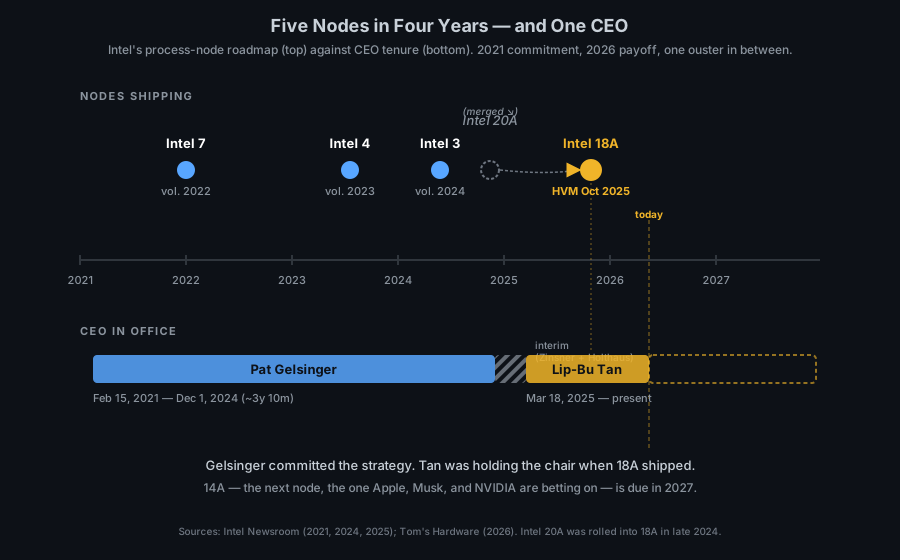
On March 23, 2021, he stood up and announced "IDM 2.0" — Integrated Device Manufacturer, version two — alongside a roadmap he called "Five Nodes in Four Years," or 5N4Y (Intel Newsroom, March 2021). Translate: five new chip-manufacturing recipes — Intel 7, Intel 4, Intel 3, Intel 20A, Intel 18A — shipping in succession through 2025. The industry standard is two years per recipe. Gelsinger was promising five recipes in forty-eight months.
The reaction was unanimous. Gelsinger himself summarized it on stage a year later: "We said five nodes in four years, and a bunch of you looked and said, 'Have you gone nuts?'" (Stratechery, 2022).
He had not gone nuts. He had read the room. In 2021, TSMC owned process leadership, Apple had just left Intel for ARM, NVIDIA was about to vacuum the entire AI training boom through TSMC silicon, and AMD's EPYC was eating Intel's server business one quarter at a time. Intel's only path back to relevance ran through manufacturing — and manufacturing leadership was three nodes deep in arrears. Gelsinger's choice was to move five times faster than the industry, or watch Intel slowly become a holding pen for a depreciating x86 license.
He chose the harder thing. He committed $20 billion to a new Arizona campus on day one, with the rest of a roughly $100 billion U.S. fab buildout following over the next five years (CNBC, January 2022). The strategy was correct. It was also fatally expensive.
The execution (2022–2024)
For three years, the recipes shipped on schedule.
Intel 7 went into volume manufacturing in 2022. Intel 4 followed in 2023. Intel 3 entered volume manufacturing in 2024 with the Sierra Forest and Granite Rapids Xeon CPUs. Intel 18A — the recipe everyone in the industry was watching as the proof-of-life node — entered high-volume manufacturing in October 2025 (Tom's Hardware, 2026). The man who had been called nuts was, by the metric he was hired against, on schedule.
The business was hemorrhaging.
In Q3 2024, AMD's data-center revenue ($3.549 billion) exceeded Intel's data-center and AI revenue ($3.3 billion) for the first time in either company's history (Tom's Hardware, 2024). Two years earlier the same Intel segment had been generating $5–6 billion at peak quarters. Intel Xeon shipments by 2024 were down more than 80% from their 2021 peak — a 13-year low (Tom's Hardware, 2024). The internal foundry segment alone lost $13 billion in 2024 (Electronics Weekly, 2025). The company's total 2024 loss came in at $18.76 billion. Free cash flow burned through another $15.66 billion in the same year — meaning the business spent $15.66 billion more on factories than it earned from selling chips (Intel 10-K, 2025).
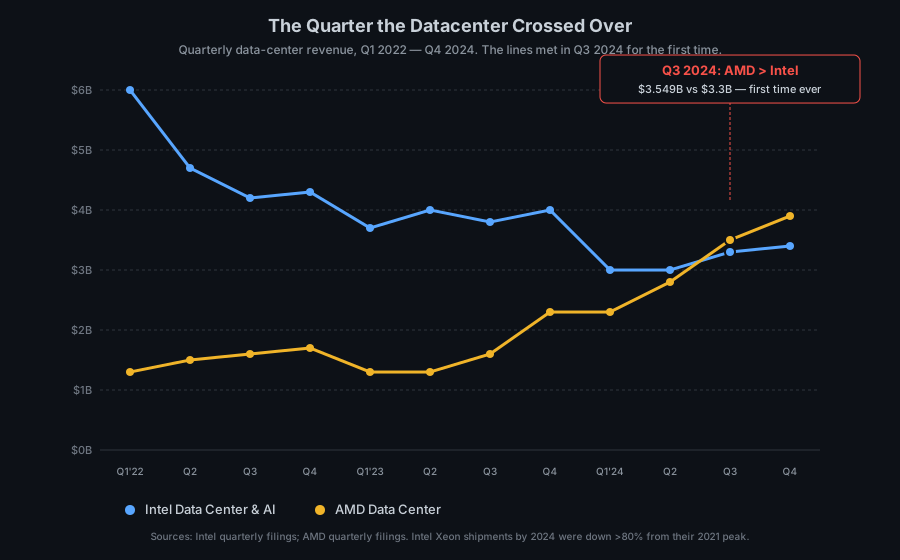
Translate: while Intel was building the new factories, the old factories were being out-priced by AMD chips that were physically being made at TSMC — the company Intel was trying to overtake. Intel was spending more to manufacture each chip than AMD was paying TSMC to manufacture the equivalent chip. The Intel side of that math had no path back to gross-margin parity until 18A was both ramping and profitable, and 18A was eighteen months away from ramping at all.
The promise had not included a profitability deadline. By the third quarter of 2024 the board started to wonder if maybe it should have. This was not Gelsinger's failure. It was the math's failure. It just happened to be on his desk.
The boardroom (December 1, 2024)
Picture a Sunday afternoon. A long oval table. Pat Gelsinger sits at one end. Frank Yeary, the independent chair, sits at the other. The agenda has one item.
Gelsinger has been CEO for three years and ten months. The strategy he authored is on schedule. The cash position is not. The board has been watching AMD outpace Intel in datacenter revenue, NVIDIA pull every dollar of AI training spend through TSMC, and Intel's own foundry segment lose $13 billion in twelve months. The directors are not asking Gelsinger to defend the plan. They are asking him to leave.
He is given the option to retire or be removed (CNBC, December 2, 2024; Bloomberg, December 2, 2024; Al Jazeera, December 2, 2024). He picks the more dignified verb. The board prepares a press release using the word retirement. Severance: $25 million. Tenure: less than four years. Intel's market capitalization at the time of the meeting is roughly half of what it was when he arrived.

The board names two interim co-CEOs — CFO David Zinsner and Client Computing chief Michelle Johnston Holthaus. Frank Yeary becomes interim executive chair. The company opens a CEO search the same week. The 5N4Y strategy still has Intel 18A to ramp and Intel 14A to deliver after that. Both will happen. Neither will happen under the man who promised them.
Tan inherits the chips (March 2025)
Lip-Bu Tan took the seat on March 18, 2025 (Intel Newsroom, March 12, 2025). He arrived with the most credible turnaround résumé in the industry: twelve years as CEO of Cadence Design Systems, during which Cadence revenue more than doubled and the stock returned over 3,200% (Intel biography).
His first communication to staff was a single sentence of diagnosis. Intel, he wrote, had become "too slow, too complex and too set in its ways" (Intel Newsroom — "Actions to Accelerate our Progress"). The fix matched the rhetoric. He flattened the org. Middle-management layers came out. Administrative workflows came out. By Q2 2025 Intel had cut 21,400 positions — 22% of the prior 96,400-person headcount, which Tan publicly described as "approximately 15%" (Computerworld, 2025).
What Tan did not do — and this is the load-bearing detail — is throw out the strategy. He kept 5N4Y. He kept the foundry pivot. He kept the Arizona buildout. He took the chips Gelsinger had spent four years committing the company to, and he made them ship without the bureaucratic tax. The strategy he inherited was correct. The execution it had been missing was a CEO willing to fire twenty thousand people in the first hundred days.

He was. Investors cheered. The stock opened up more than 10% on the day his appointment was announced (CNBC, March 2025). The 18A ramp continued. The 14A PDK shipped to lead customers a few months later. The strategy started looking, for the first time since 2021, like it might actually pay off.
It needed one more thing first.
The conference room (August 22, 2025)
Picture a different room, eight months later, this one in a different city. The administration that spent eighteen months on the campaign trail calling the Biden-era CHIPS Act a $52 billion handout is in the room. So is Intel's new CEO. So is the U.S. Commerce Department. The deal on the table is straightforward in the way that only deals between a sovereign government and a national-champion company can be straightforward.
The previous administration had committed $7.86 billion in CHIPS Act grants to Intel and disbursed $2.2 billion. The new administration has the remaining $5.66 billion sitting unpaid. It does not want to write a grant. It wants equity. So the unpaid grants ($5.7 billion) plus a Secure Enclave allocation ($3.2 billion) — totalling $8.9 billion — get converted into 433.3 million shares of Intel common stock at a discounted price of $20.47 per share (Intel Newsroom, August 22, 2025; GovConWire, August 22, 2025). That is a 9.9% stake. The U.S. government — the same federal government that spent the prior administration apologizing for the CHIPS Act's price tag — becomes Intel's single largest shareholder.
The deal also includes a poison pill: a five-year warrant for an additional 5% of Intel at $20 per share, exercisable only if Intel ceases to own 51% or more of its foundry business. In English: try to spin Intel Foundry out and the federal government quietly takes another 5% of your company at a price you cannot argue with. The government has no board seat. It has agreed to vote with management. Translate: it owns a tenth of you, it can buy more if you try to sell the part it cares about, and it has promised to be polite about it.

By the next morning the deal had generated a $1.9 billion paper gain at Intel's open (Fortune, August 23, 2025). By late November 2025, the government's $8.9 billion stake was worth approximately $36 billion (The Next Web, November 2025; Reason, November 2025). The Trump administration runs, on the books, the single most profitable trade in the history of the U.S. Treasury — using the unspent appropriation of the act it spent the campaign cycle calling wasteful. Nobody in either party planned for it to work this way. Nobody, in either party, is sending the money back.
NVIDIA writes a check for $5 billion in September 2025, finalizing in December at $23.28 per share for a 4.4% stake (NVIDIA Newsroom, September 2025; Tom's Hardware, December 2025). NVIDIA — the company that spent four years vacuuming up Intel's lunch — wrote a check to keep Intel alive, because Apple, Tesla, Microsoft, and the U.S. government all need someone besides TSMC. Within three months NVIDIA's stake was up roughly $2.5 billion on the mark.
Elon Musk announces Terafab in March 2026 — a $55-to-$119 billion chip megaproject in Austin built for Tesla, xAI, and SpaceX, using Intel's 14A node as its base process (TechCrunch, April 2026; CNBC, May 2026). Apple signs a preliminary chip-manufacturing agreement with Intel on May 8, 2026 — Tim Cook went into a White House meeting with Donald Trump and came out endorsing the diversification of Apple silicon away from TSMC (9to5Mac, May 8, 2026; Tom's Hardware, May 8, 2026). Intel stock closes the day at $130.57. An all-time high.
The strategy Gelsinger committed Intel to in March 2021 is working in May 2026. Gelsinger is not.
The numbers, finally
Q1 2026 (Intel IR, April 23, 2026):
- Revenue: $13.6 billion — the midpoint of management guidance was $1.4 billion lower.
- Non-GAAP EPS: $0.29 — the version that excludes one-time charges and is the metric Wall Street tracks. Guidance had been "approximately break-even."
- Non-GAAP gross margin: 41.0% — 650 basis points above guidance. Translate: every dollar of chip Intel sells now keeps forty-one cents before marketing and R&D, versus the 32.6% trough of 2024.
- Sixth consecutive earnings beat.
- Data Center & AI revenue: up 22% year-over-year. The same segment AMD overtook in Q3 2024 is now growing again.
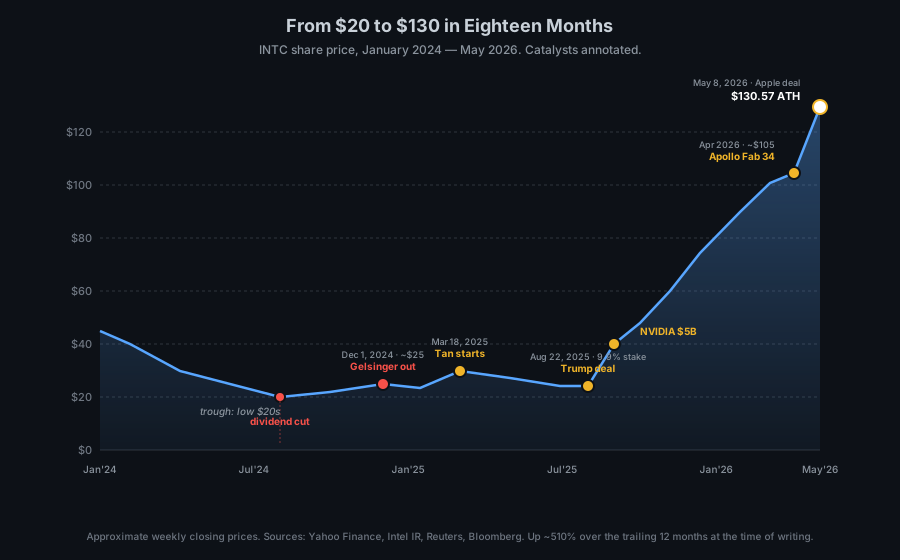
In April 2026, Intel announced it was repurchasing Apollo Global Management's 49% stake in the Fab 34 joint venture in Ireland for $14.2 billion in cash and new debt (Intel Newsroom, April 1, 2026). Apollo had paid $11.2 billion for that stake in 2024, when Intel needed the cash badly enough to mortgage its newest leading-edge fab. Apollo collected a $3 billion gain for showing up to a board meeting in Dublin for eighteen months. Private credit does not need to work harder than that.
The stock as of May 12, 2026 is approximately $129, up about 510% over twelve months (Yahoo Finance, 2026). Market capitalization is approximately $616–650 billion. The deep-value window — the period in late 2024 when Intel was trading in the low $20s — is closed.
What could break this
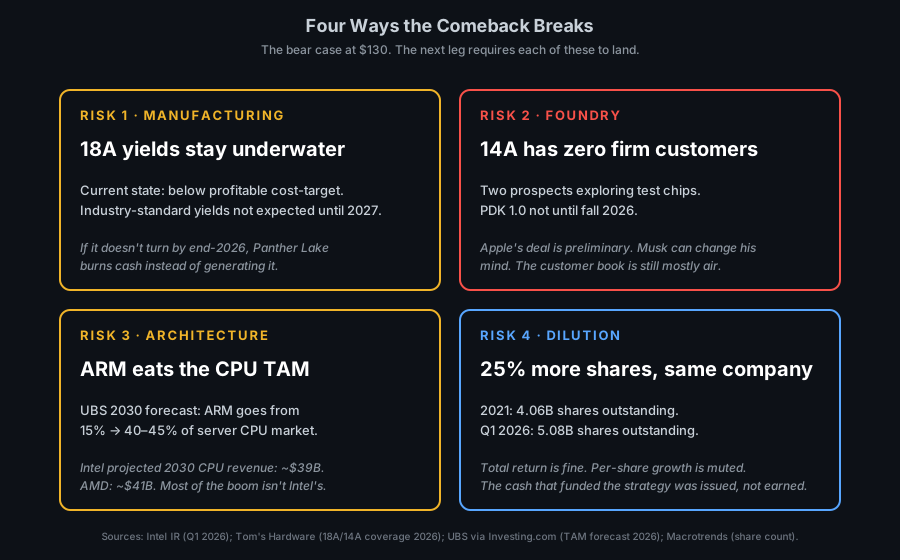
The 18A yields are still below profitable cost-target levels as of early 2026, with industry-standard yields not expected until 2027 (Tom's Hardware, 2026). Translate: the new factory line is open and the products are shipping, but the chips still cost more to make than they sell for. Intel has guided that this changes by the end of 2026. If it does not, the Panther Lake ramp burns cash instead of generating it.
The 14A node — the one with Apple's preliminary agreement and Musk's Terafab betting on it — has zero firm external customers as of May 2026 (Tom's Hardware, 2026). Two prospects exist. The PDK 1.0 — the design kit that lets a customer commit real money — is not expected until fall 2026. Apple's deal can fall apart. Musk can change his mind. Intel publicly expects firm 14A commitments to start arriving in the second half of 2026, but as of May, the customer book mostly still consists of "we are negotiating."
The agentic AI CPU thesis — the one driving the Xeon 6 demand that beat Q1 2026 guidance by $1.4 billion — does forecast a server CPU total addressable market of $170 billion by 2030, according to UBS (UBS via Investing.com, 2026). The same UBS forecast has ARM going from 15% to 40–45% of that market. Translate: the agentic AI boom is real, the CPU side of it is real, and most of the upside is going to a competitor architecture. Intel's projected 2030 CPU revenue in that forecast is approximately $39 billion. AMD's is $41 billion. The data center is splitting three ways, not coming back.
And then there is the share count. Intel had roughly 4.06 billion shares outstanding at the start of 2021. As of Q1 2026 it has 5.08 billion. That is 25% dilution in five years — the silent overhang on every per-share growth metric the bull case talks about. Existing holders are still net winners on total return; the dilution shows up on the per-share metrics, not the absolute equity value. But on per-share growth, it is real. The cash-raising that funded the strategy is being paid for by the people who already owned the strategy.
So the piece that opened with the nodes shipped, the CEO did not should close with the harder question, which is the one the boardroom now owns: who is running the company that ships the strategy you are betting on right now — and is the board patient enough to let them?
Disclosure: I held Intel earlier. I sold it. I was wrong about the strategy outliving the strategist. The note in that conference room — the one about not being asked to defend the plan, only to leave — is what I should have read in 2024 and didn't. Intel's next move is the one the boardroom owns. The next disclosure is the one I won't write.
Sources
- Intel CEO Pat Gelsinger Announces 'IDM 2.0' Strategy — Intel Newsroom, March 23, 2021.
- An Interview with Intel CEO Pat Gelsinger About Intel's Progress Towards Process Leadership — Ben Thompson, Stratechery, 2022. (Source of the "Have you gone nuts?" quotation.)
- Intel to invest up to $100 billion in Ohio chip plants — CNBC, January 21, 2022.
- Intel's pivotal 18A process is making steady progress, but still lags behind — Tom's Hardware, 2026.
- For the first time ever, AMD outsells Intel in the datacenter space — Tom's Hardware, 2024.
- Intel data center CPU sales hit the lowest point in 13 years — Tom's Hardware, 2024.
- Intel loses $18.8bn — Electronics Weekly, January 2025.
- Intel 2024 Form 10-K — Intel Corporation, January 2025.
- Intel CEO Pat Gelsinger ousted by board after disastrous performance — CNBC, December 2, 2024.
- Intel CEO Pat Gelsinger Forced Out by Board — Bloomberg, December 2, 2024.
- Intel CEO Pat Gelsinger forced out in surprise move — Al Jazeera, December 2, 2024.
- Intel Appoints Lip-Bu Tan as Chief Executive Officer — Intel Newsroom, March 12, 2025.
- Lip-Bu Tan biography — Intel Newsroom.
- Actions to Accelerate our Progress — Intel Newsroom, 2025.
- Intel to lay off 22% of workforce as CEO Tan signals 'no more blank checks' — Computerworld, July 2025.
- Intel appoints Lip-Bu Tan as CEO to orchestrate turnaround — CNBC, March 12, 2025.
- Intel and Trump Administration Reach Historic Agreement — Intel Newsroom, August 22, 2025.
- US Government to Acquire 9.9% Stake in Intel — GovConWire, August 22, 2025.
- Trump's Intel deal has already given the government a $1.9 billion gain on paper — Fortune, August 23, 2025.
- The US government's Intel stake is now worth $36 billion — The Next Web, November 2025.
- Trump slammed Biden's $52 billion CHIPS Act. Then he used it to buy a federal stake in Intel. — Reason, November 29, 2025.
- NVIDIA and Intel to Develop AI Infrastructure and Personal Computing Products — NVIDIA Newsroom, September 18, 2025.
- Nvidia gives Intel a lifeline with $5 billion common stock deal — Tom's Hardware, December 2025.
- Intel signs on to Elon Musk's Terafab chips project — TechCrunch, April 7, 2026.
- Elon Musk's Terafab chip factory in Texas could cost up to $119 billion — CNBC, May 6, 2026.
- Apple and Intel have reached a deal to produce future chips — 9to5Mac, May 8, 2026.
- Apple reportedly strikes deal for Intel to make some of its chips — Tom's Hardware, May 8, 2026.
- Intel Reports First-Quarter 2026 Financial Results — Intel IR, April 23, 2026.
- Intel to Repurchase 49% Equity Interest in Ireland Fab Joint Venture — Intel Newsroom, April 1, 2026.
- Intel says it has two prospective customers for 14A — Tom's Hardware, 2026.
- UBS: Agentic AI shift signals massive expansion for server CPU market — UBS via Investing.com, 2026.
- Intel Corporation (INTC) Stock Price — Yahoo Finance, May 2026.