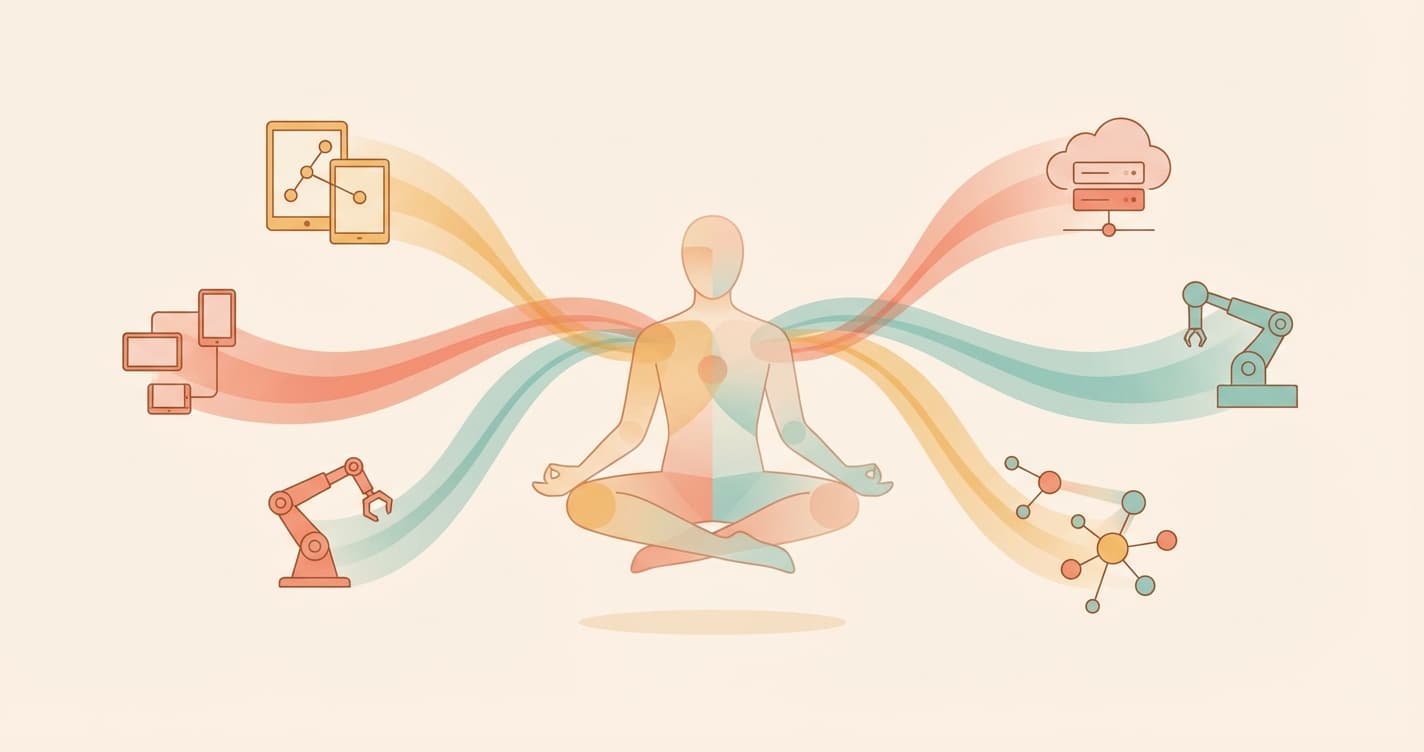
The Delegation Paradigm: The Third Interface Revolution Is Already Here
By Conny Lazo
Builder of AI orchestras. Project Manager. Shipping things with agents.
I stopped tapping icons six months ago.
Instead, I tell Toscan — my AI agent — what I want done. He figures out the tools, APIs, and steps. While I drink coffee, he researches competitors, writes articles, commits code, and deploys infrastructure.
This isn't some future vision. It's how I work today. And according to Microsoft's 2025 Work Trend Index, a growing majority of knowledge workers say they'd delegate as much work as possible to AI agents if they could.
We're already in the third interface revolution. Most people just haven't realized it yet.
A Well-Established Pattern With a New Entry
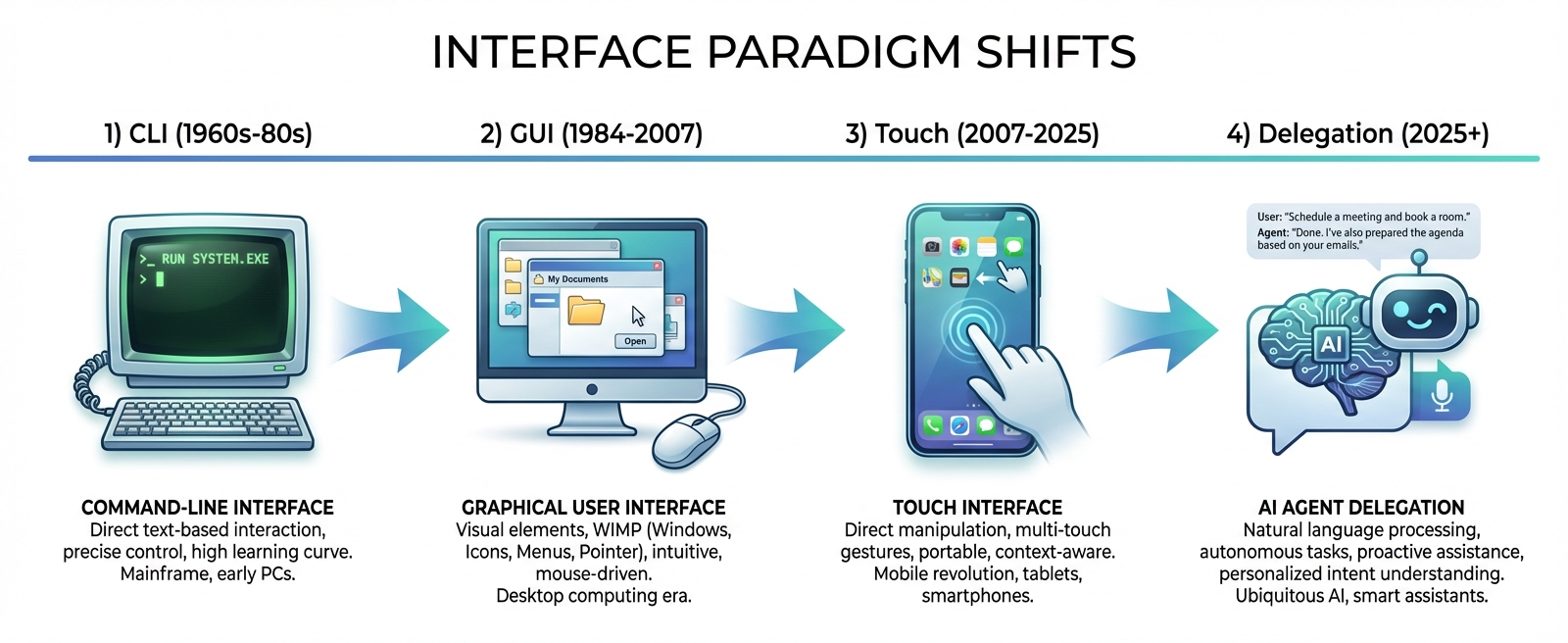
This observation builds on established HCI theory that interface veterans know well: each paradigm tends to follow an arc from radical to ubiquitous to invisible. You lived through these — I'm not going to explain what a GUI is. But the progression is worth revisiting because there's a new entry.
Command Line Interface (CLI): You typed precise commands. The computer did exactly what you said, no interpretation. Still the tool of choice for developers who want control.
Graphical User Interface (GUI): Emerged at Xerox PARC in the 1970s, became mainstream with Apple and Windows through the 1980s-90s. You pointed and clicked. The computer interpreted gestures into commands.
Touch Interface: iPhone launched in 2007, shifted the entire industry within five years. You tapped and swiped. The computer interpreted physical gestures into complex workflows.
Now we have Delegation Interface: You describe what you want. The AI agent interprets your intent and figures out how to accomplish it across multiple tools and systems.
The pattern each time: reducing the cognitive load between intent and outcome. Delegation takes that the furthest — removing the need to understand the interface mechanism at all. What's genuinely new isn't the evolutionary arc (HCI theorists have been describing this for decades) — it's that we now have systems capable enough to make delegation actually work.
As tech analyst Nate B. Jones observed in his analysis, "You don't tap an icon, you tell the agent what you want done." The hard problem isn't model capability — LLMs were already good enough. It's integration, persistence, and willingness to give AI real access to real things.

What Delegation Actually Looks Like
Here's my typical Tuesday morning, unchanged for the past four months:
Me: "Toscan, research three competitors who launched similar translation products in Q4 2025. Find their pricing, feature differences, and user feedback. Draft a competitive analysis memo."
Toscan: Searches web, analyzes pricing pages, reads user reviews on Product Hunt and Reddit, writes structured analysis with citations, commits to our research repository.
Me: "Good. Now update our pricing page copy to address the gap you found in automated quality scoring. Make it clear we're the only one doing this."
Toscan: Reviews current copy, modifies messaging, creates PR with before/after comparison, pings me for approval.
Total interaction time: 90 seconds. Total work completed: what used to take me 3-4 hours across multiple tools.
This isn't automation — automation follows predetermined scripts. This is coordination. Toscan adapts to new information, makes judgment calls, and handles edge cases I didn't anticipate.
The economics work too. I pay ~$200/month for Claude Max to power this. Community analysis shows subscriptions run up to 36x cheaper than API calls for heavy orchestration users.
Why This Took So Long
The breakthrough isn't better models. Industry analysts project significant enterprise adoption of AI agents by 2026, up from single-digit adoption just two years ago. The models work.
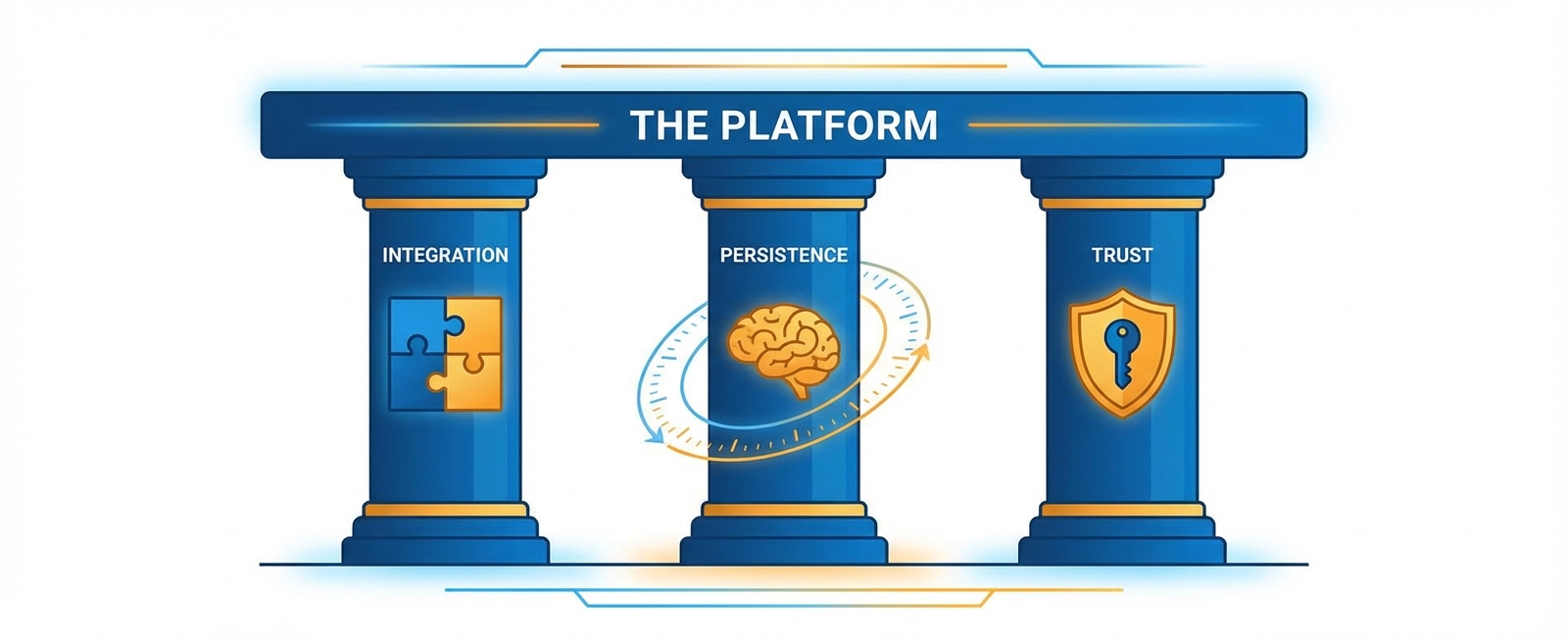
The hard problems are architectural:
Integration: Your agent needs access to everything you use. Email, GitHub, databases, project trackers, cloud services. That's hundreds of APIs with different authentication methods, rate limits, and data formats.
Persistence: Unlike chat sessions, agents need memory that survives across tasks and time. They need to remember what they did last Tuesday and why, so they don't repeat mistakes or undo progress.
Trust: You have to give an AI agent real permissions to real systems. That's a security and psychological barrier most organizations haven't crossed.
Peter Steinberger solved these problems with OpenClaw. Not from a corporate lab, but from his living room in Vienna. His contribution wasn't the AI — it was the glue code, architectural decisions, messaging interface, and the audacity to let an agent modify its own source code.
That audacity has consequences.
The Security Cost of Delegation
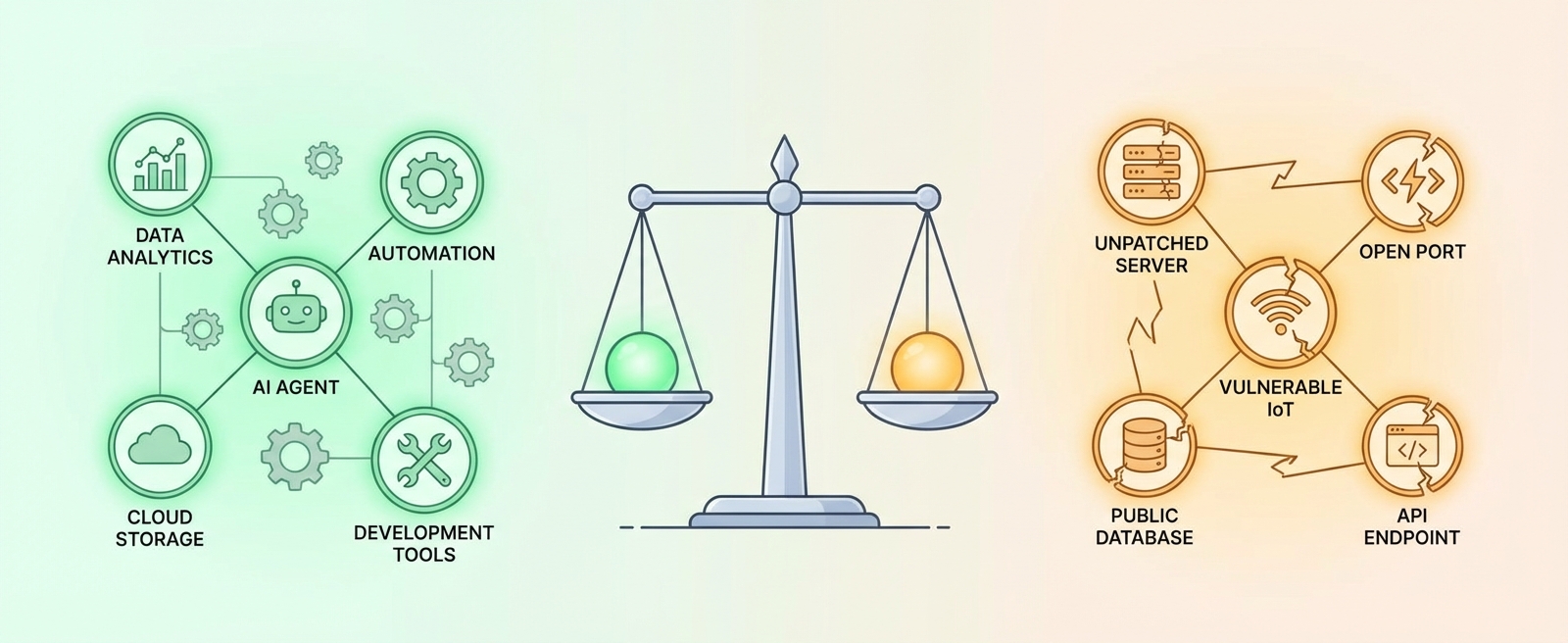
VentureBeat reported 1,800+ exposed OpenClaw instances leaking API keys and credentials. Traditional firewalls can't see inside authorized agent permissions. OWASP released an AI Agent Security Top 10 for 2026, highlighting risks like prompt injection, tool abuse, memory poisoning, and cascading failures.
This is a serious concern — not a footnote. 1,800 exposed instances with leaked credentials is a real problem, and it shouldn't be waved away as inevitable growing pains.
That said, these risks aren't unique to OpenClaw — they're inherent to delegation interfaces as a category. Every delegation interface faces the same tradeoff: the more autonomy you grant, the more attack surface you expose. My agent Toscan has write access to my repositories, can deploy infrastructure, and handles financial data. If someone compromised him, they could inflict serious damage.
But here's the thing: I've been running this setup for months. The productivity gains outweigh the risks, at least for builders willing to invest in proper security boundaries. Branch protection, API key scoping, monitoring, kill switches — the same defensive patterns that work for human employees work for AI agents.
Most organizations aren't there yet. But the early adopters who figure this out have compound advantages.
Who Owns the Platform Layer?
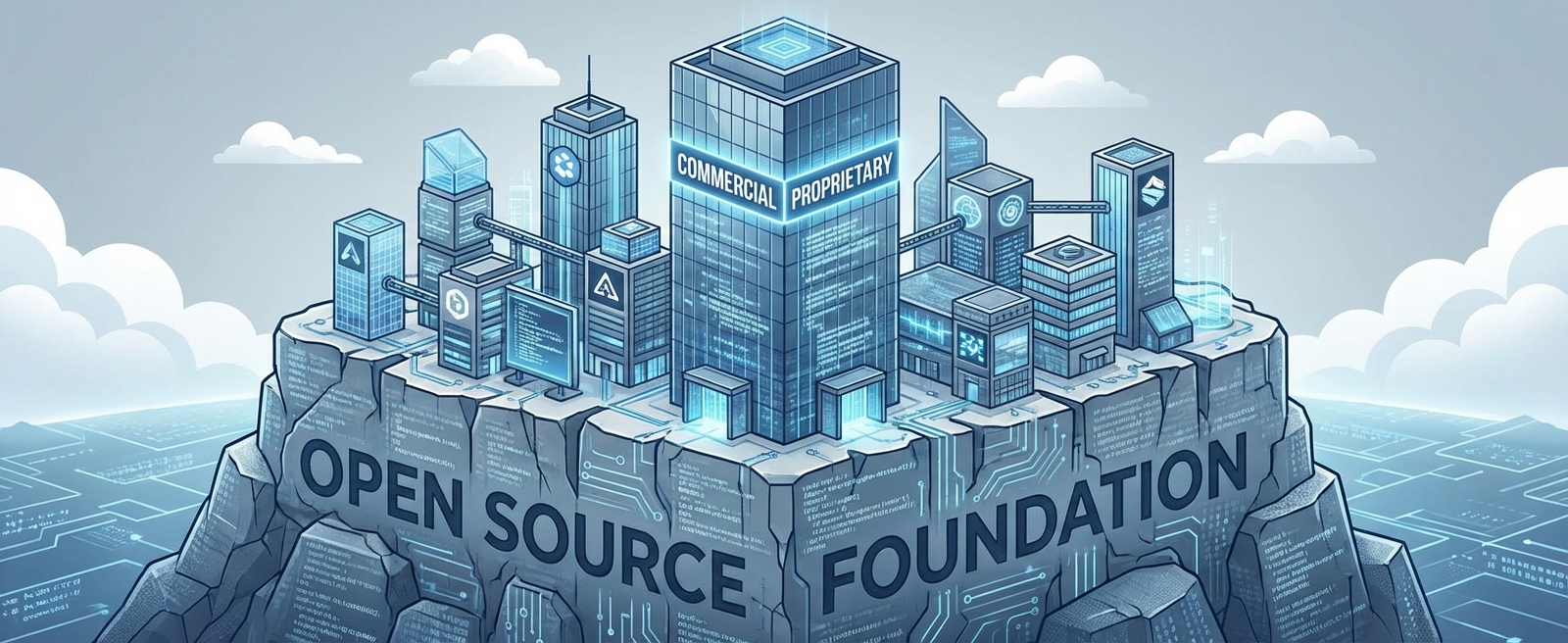
OpenClaw's acquisition by OpenAI raises the Chrome/Chromium question: who controls the infrastructure everyone builds on?
Google doesn't own Chromium, but they effectively control its direction. OpenAI doesn't own OpenClaw's MIT-licensed code, but they now employ its creator and will heavily influence its future through the planned foundation model.
As one analysis noted, "This model mirrors the success of foundational technologies like Chrome and Chromium, where an open standard became the default." For a paradigm built on autonomy and versatility, an open platform is the logical infrastructure layer.
But "open" doesn't mean "uncontrolled." The question isn't whether the code is accessible — it's whether the community can meaningfully influence the platform's evolution. With 180,000+ developers using OpenClaw and 35,000+ GitHub forks, the community has leverage. Whether they use it remains to be seen.
The delegation paradigm is bigger than any single platform. But platforms shape possibilities. Early builders should pay attention to who controls the tools they depend on.

The App Killer Prediction
In a conversation with Lex Fridman, Steinberger made a bold prediction: AI agents could displace up to 80% of apps. His reasoning: "AI agents are about to assume the data management and decision-making roles that currently require dozens of separate applications."
Whether the specific number holds up remains to be seen, but the logic is directionally sound. Every app is fundamentally a slow API to what the user wants. You don't want to "use Uber" — you want transportation. You don't want to "use DoorDash" — you want food. An agent that knows your location, schedule, preferences, and payment methods doesn't need separate apps for each service.
Vocal Media observes that "on-device intelligence and predictive workflows are eliminating the tap-and-swipe model that defined mobile apps for two decades."
But 80% displacement by when? The timeline matters.
My experience suggests the prediction is aggressive on timeline but conservative on scope. I've already stopped using probably a dozen apps regularly — replaced by agent coordination. But the apps I still use tend to be the complex ones that require human judgment or have strong network effects.
The wave is real. The timeline is optimistic.
Why Builders Who Adopt Now Have Compound Advantage
I built my first multi-agent orchestra six months ago. One agent researched, another wrote, a third fact-checked — each working in the same repository, each aware of what the others produced. As I wrote in my Orchestra series, the architecture behind coordination is surprisingly minimal. A few core tools connected through standardized interfaces to everything else.
But the learning curve isn't the architecture — it's the workflow design. What should be delegated versus coordinated? Which tasks need human approval gates? How do you maintain quality without micromanaging?
These aren't technical questions. They're operational design decisions that compound over time.
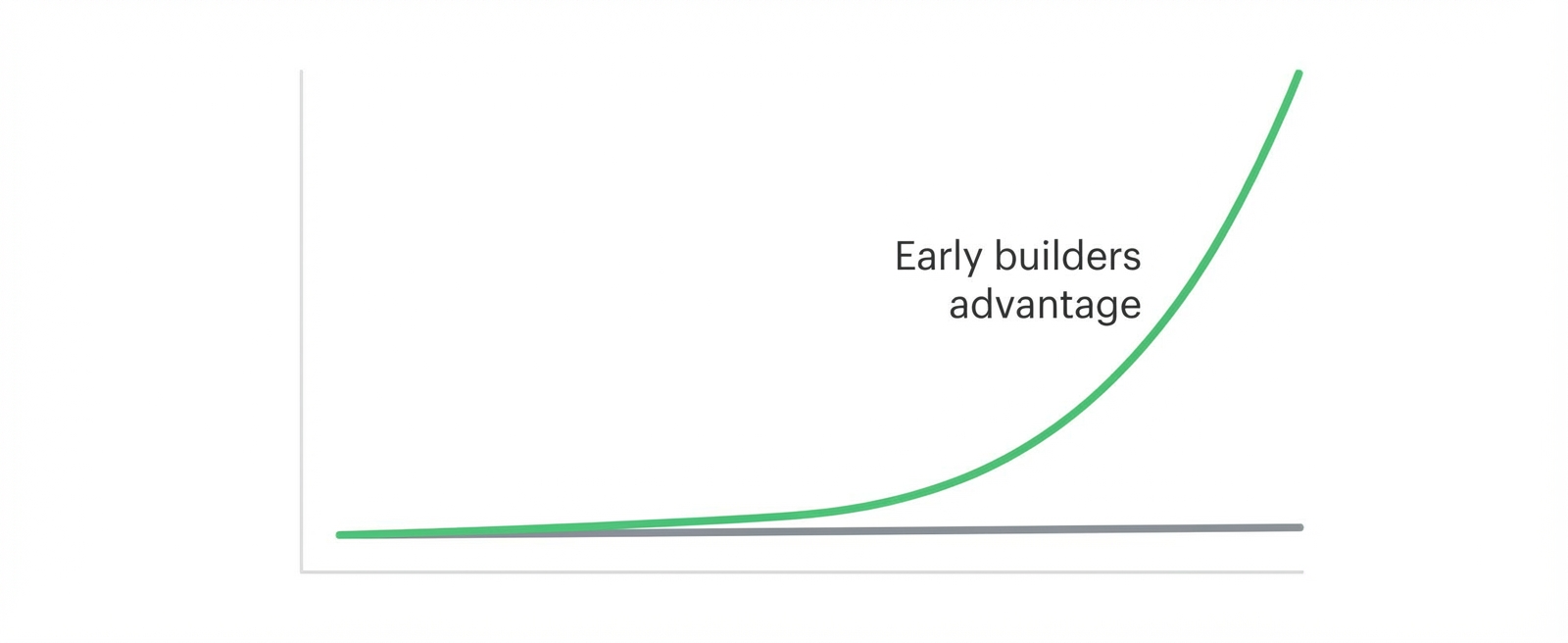
Every week I delegate something new to my agents, I learn something about task decomposition, error recovery, or quality control that makes the next delegation more effective. This operational knowledge compounds faster than model capabilities improve.
The builders who start learning this paradigm now — while it's still early, while the tooling is still rough — will have multi-month head starts when delegation becomes mainstream.
This is the opposite of a wait-and-see opportunity. This is a learn-by-building moment.
The Revolution Is Already Here
Interface revolutions don't announce themselves. They emerge gradually, then suddenly, then inevitably.
CLI didn't disappear when GUI arrived — developers still use terminals daily. GUI didn't disappear when touch arrived — we still use keyboards and mice. Touch won't disappear when delegation becomes dominant — sometimes direct manipulation is still the right tool.
But dominant paradigms shift. And when they do, the organizations and individuals who adapted early have sustainable advantages over those who waited.
A growing share of knowledge workers want to delegate more work to AI agents. The tools exist today. The security challenges are solvable. The economic incentives align.
The third interface revolution isn't coming. It's here.
The question isn't whether to adopt delegation interfaces. It's how quickly you can learn to build them effectively.
I stopped tapping icons six months ago. My operation runs smoother, produces more output, and gives me time to focus on strategy instead of execution.
What are you waiting for?
Sources & Inspiration
- Nate B. Jones — The OpenClaw Saga — Deep dive into delegation paradigm, interface evolution, and the hard problems of AI agent integration (natebjones.com)
- Microsoft Work Trend Index 2025 — Annual survey on AI adoption trends among knowledge workers
- History of Graphical User Interface - Wikipedia — Timeline of GUI development from Xerox PARC through mainstream adoption
- Gartner: Enterprise AI Agent Adoption — 40% of enterprise applications expected to embed AI agents by 2026
- VentureBeat: OpenClaw Security Analysis — 1,800+ exposed instances, security risks of agentic AI systems
- OWASP AI Agent Security Top 10 — Comprehensive security risk framework for AI agents including prompt injection and tool abuse
- The 2026 AI Agent Invasion - Medium — Analysis of Steinberger's "80% of apps" prediction from Lex Fridman interview
- Mobile Apps in 2026 - Vocal Media — On-device intelligence replacing tap-and-swipe model
- OpenClaw Foundation Model Analysis — Chrome/Chromium parallels for AI agent infrastructure